|
Background:
Born in 1967 in Alice Springs, Trephina grew up with many uncles,
aunties and cousins doting on her as a beautiful young
Aboriginal girl, she was the only child in her family.
Trephina’s painting talents started at a
very young age. As a young girl she used to sit and
watch her uncles, aunties, cousins and friends paint for
hours at a time. She would then pick up a stick and draw
her art in the dirt.
With her mother and aunty a big
influence in her life, Trephina went to the English
speaking school at Alice Springs. Even though English
became Trephina’s first language, she was taught
Luritja, the language of her family and Elders at home.
Trephina, in her own words, had the best of both worlds.
The language skill she acquired stood
Trephina in good stead. Acknowledged as a Luritja
language specialist, she did work as an interpreter and
in conjunction with colleagues and the Alice Springs
Institute for Aboriginal Development, was a valuable
contributor to an Aboriginal-English dictionary.
However, Trephina’s main love is
painting. Her artwork drawing on the knowledge acquired
in her youth, and the stories her family and Elders passed
down.
For the Aboriginal people, the creation of art using the natural
resources around them, dates back many thousands of
years in Aboriginal culture. Art had revolved around
symbolism and a limited set of colours, created by
crushing ochres found in the region. Much of the early
works were found depicted on rocks and in caves. The
early 70s saw a change in the tools they used and a
shift in style, with many
Aboriginal artists expanding beyond the original colours
of ochre, whilst using the modern
medium of acrylic and canvas, interpreting their dream
time and culture through the classic ‘dot-style’ that is
synonymous with Aboriginal art movement.
Many of Trephina’s early work is done in
this ‘dot-style’. Although she still produces artwork in this
style, Trephina like many artists, has evolved from the
natural colours reflected in the landscape of ‘Central
Australia’ to expanding to a larger palate of colours.
Other changes can also be seen in her work, as she
tentatively paints in masterful strokes of vibrant
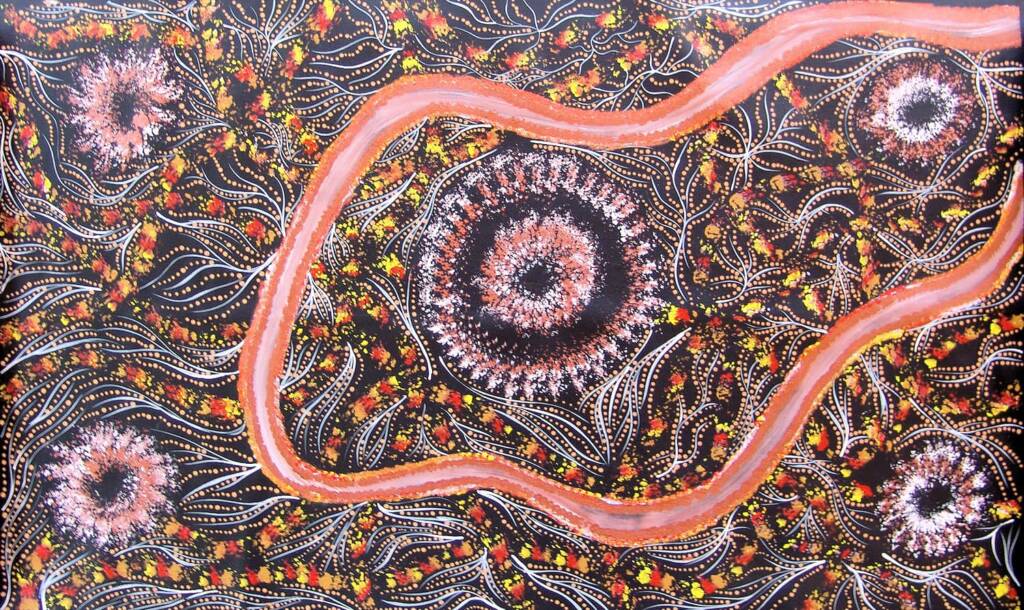
hues, producing her very popular ‘Tjanpi Kampanyi’
(Burning Grass). These beautiful works are evocative and
captures the very essence of Aboriginal culture:
...for generations our people have burnt off the bush land for
hunting purposes, safety and regrowth.
In casual conversation, it was
interesting to hear from Trephina, how the style
developed. She use to do it as a background and really
liked the brush strokes on it’s own. Even back then, it
had evoked memories of burning grass. Now taking centre
stage, each new ‘Tjanpi Kampanyi’ would burn in its own
flames. With each canvas, Trephina would vary the
colour, some showing black in the background, some
white, others with bright orange-yellow flames. Even the
size of the canvas would vary, from small two panel
pieces, to larger 2 metre long paintings.
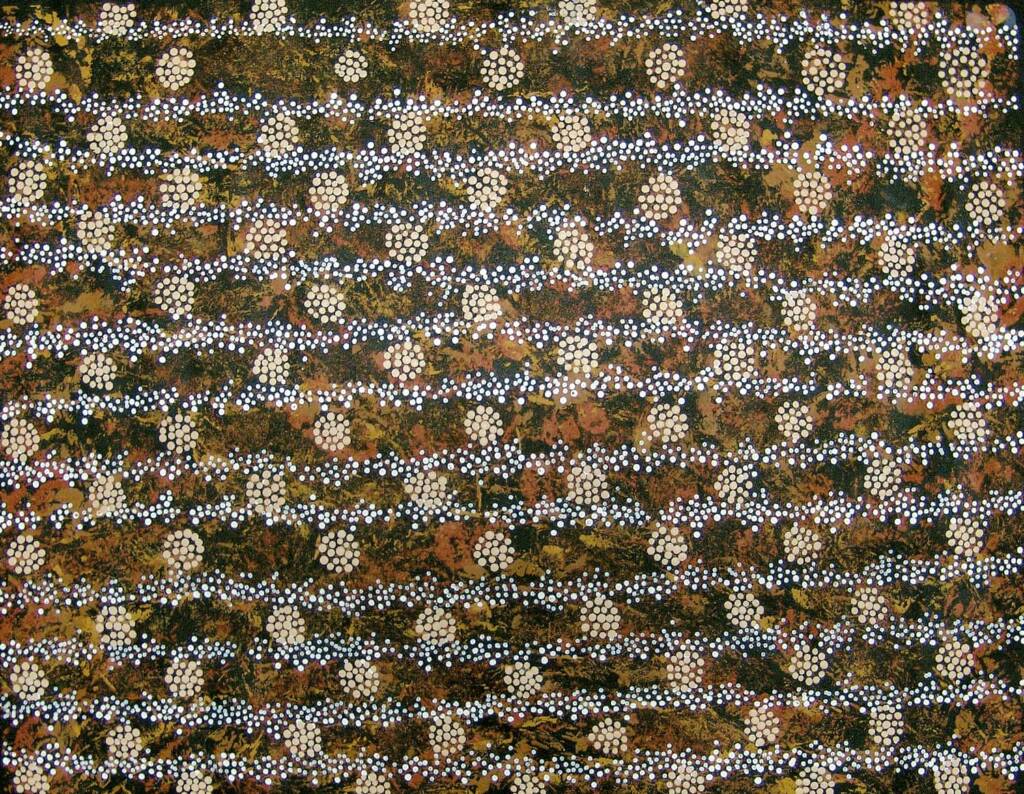
New works are emerging from her brush
stokes, reflecting this abstract style, as can be seen
in her recent ‘Bush Onions’ and ‘Bush Honey’. With many more ideas
filling her head, and the penchant for trying new ideas,
we look forward to seeing Trephina’s future works.
Trephina’s paintings represent her
family’s culture, upbringing as a young child, and
stories as told by her Elders. Her paintings include
Aboriginal symbolism of vegetation, food sources,
watering holes and the wildlife of Central Australia.
Sometimes, she would wake up in the early morning with a
memory resonating from her past. These may be a story or
answer to some current piece she is working on, or the inspiration for a new
painting.
Typical of many Aboriginal painters,
Trephina before doing a new style of painting, would
seek permission from her Elders. Some dreamtime stories
are taboo, whilst other would still need the permission
of the Elders.
Trephina’s paintings have been bought by
visitors to the Alice Springs area, over many years, and
are displayed in houses all over Australia and the
World. More recent works have been exhibited and sold
in an exhibition in
Melbourne. Many of her works has been created
under the name of Trephina Sultan, although she still continues to use this name on different works,
some of her works
will also bear her Aboriginal name of ‘Thanguwa’. The
equivalent meaning in English is ‘scent’.
As a mother, Trephina has five children, 2 sons and 3
daughter, all of whom paint.
Her young son Rueben Sultan is also following in his mother’s
footstep. To see his recently sold work,
click here. |