
SpinifexSoft Spinifex (Triodia pungens) Weeping Spinifex (Triodia brizoides)
Spinifex (Triodia, family Poaceae)
The Poaceae family of flowering plants is a group commonly called ‘grasses’, containing over 600 genera and over 9,000 species.
This family also contains the genus Spinifex pertaining to the ‘coastal grasses’, although it does not contain the ‘spinifex grasses’ found throughout the outback and arid regions of central Australia, who belong to the genus Triodia.
Unlike the ‘coastal grasses’, Triodia is a large genus of tussock forming grasses that are endemic to Australia, which is more commonly known as ‘spinifex’ and is often what people mean when they talk about spinifex and spinifex grass.
The Australian tribe of grasses, Triodieae or ‘spinifex’, was well known to the early explorers of the continent’s centre. The tough sharpened leaf blades of this ‘porcupine grass’ were a dreaded obstacle to the adventurers’ vain pursuit of fertile lands and inland seas – a real Australian ‘thorn in the side’. For most, the endless spinifex grasslands symbolised a harsh and monotonous, if not hostile Australian desert, a place to heroically endure rather than celebrate.The genus Triodia are a perennial Australian grass that have pointed leaves, that are often sharp.1
Source: Jim Mant, Australian National University
Triodia and Plechrachne spp of spinifex are commonly found in arid regions, characteristic of the Australian outback. They are found growing on low-nutrient soils of sand plains and low rocky mountain ranges, but also occur on rocky outcrops along the coasts. Triodia species (which now include the species formerly classified in Plectrachne) are also called “porcupine grass” or “spinifex” , but they should not be confused with grasses in the genus Spinifex which is found only in sandy habitats along coastal beaches.
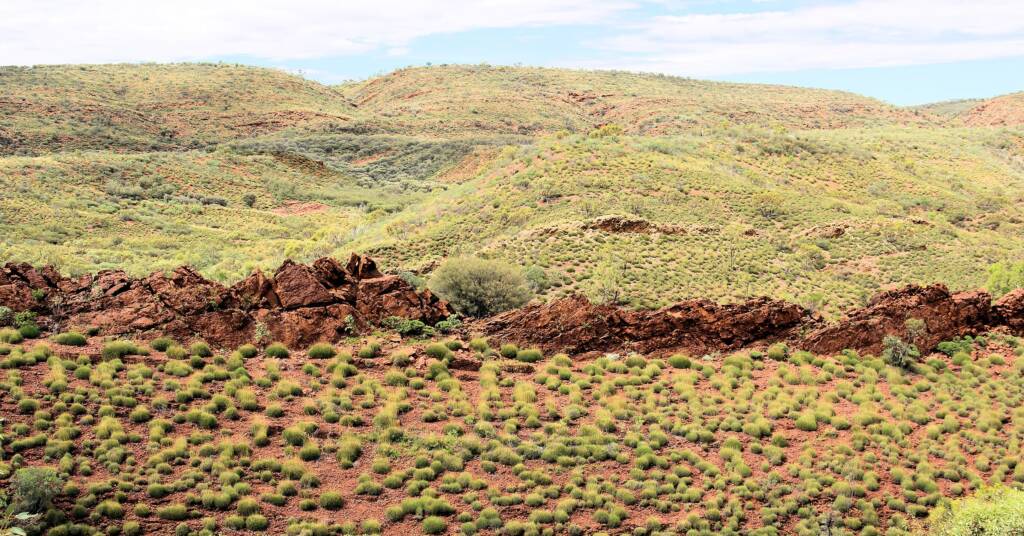
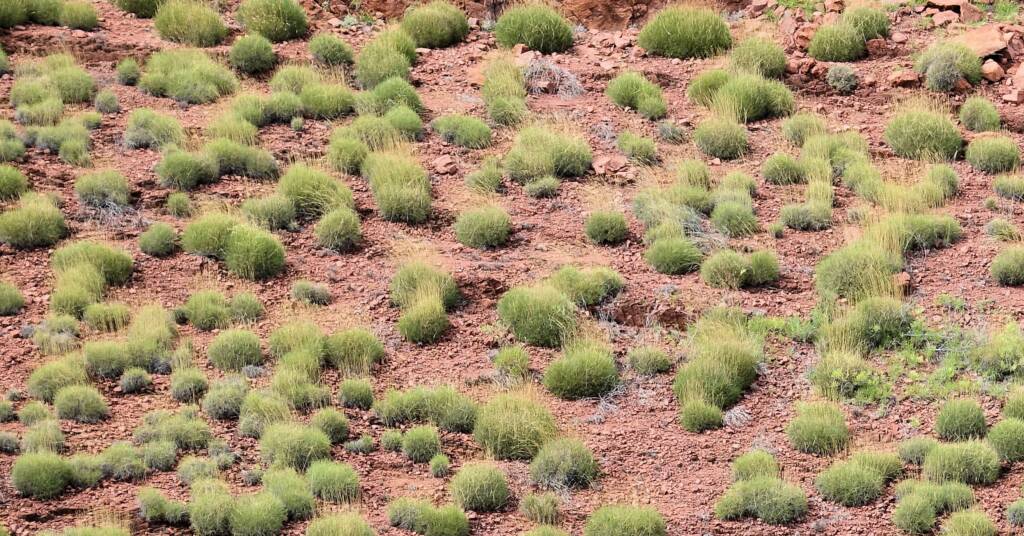
Hummock-forming spinifex appear as mounds up to 1 metre in height. They are often found to be one of the major vegetation communities within the ranges
The hummock grasses in the genus Triodia is said to dominate over 20% of Australia’s mainland, growing on low nutrient soils found in sand plains and rocky ranges of the arid centre, as well as on rocky outcrops along the coasts.
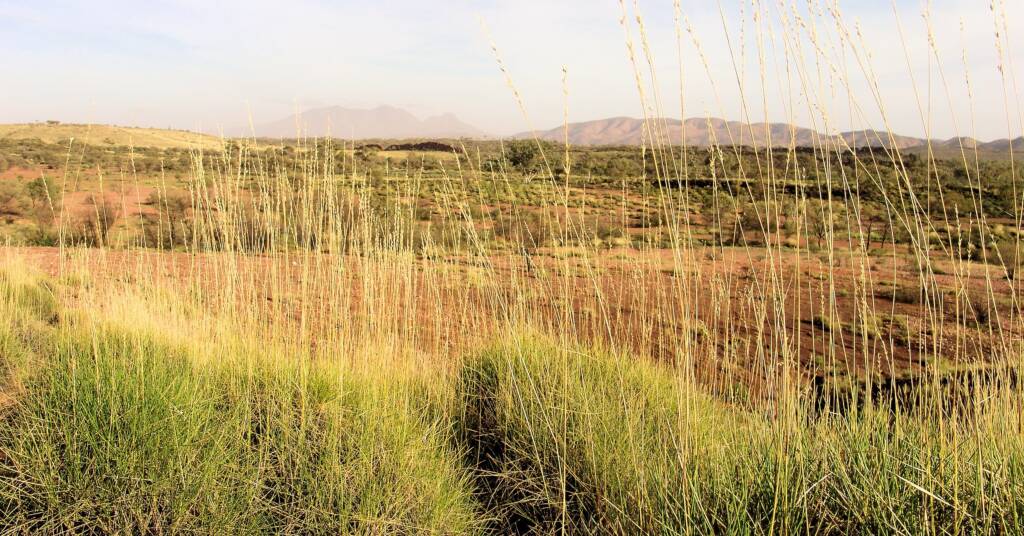
- Mount Sonder through Spinifex / Triodia schinzii, West MacDonnell Ranges NT
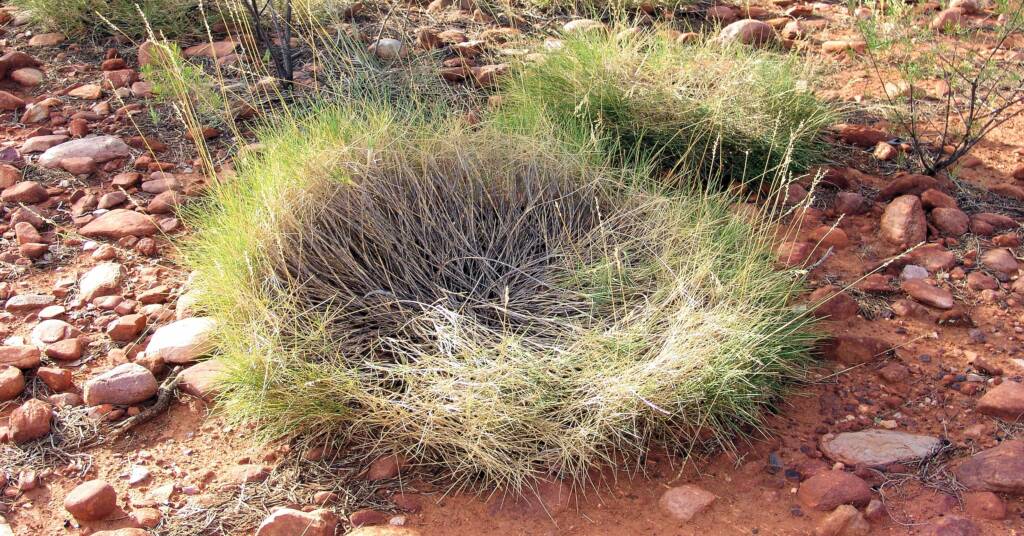
- Spinifex / Triodia, West MacDonnell Ranges, NT
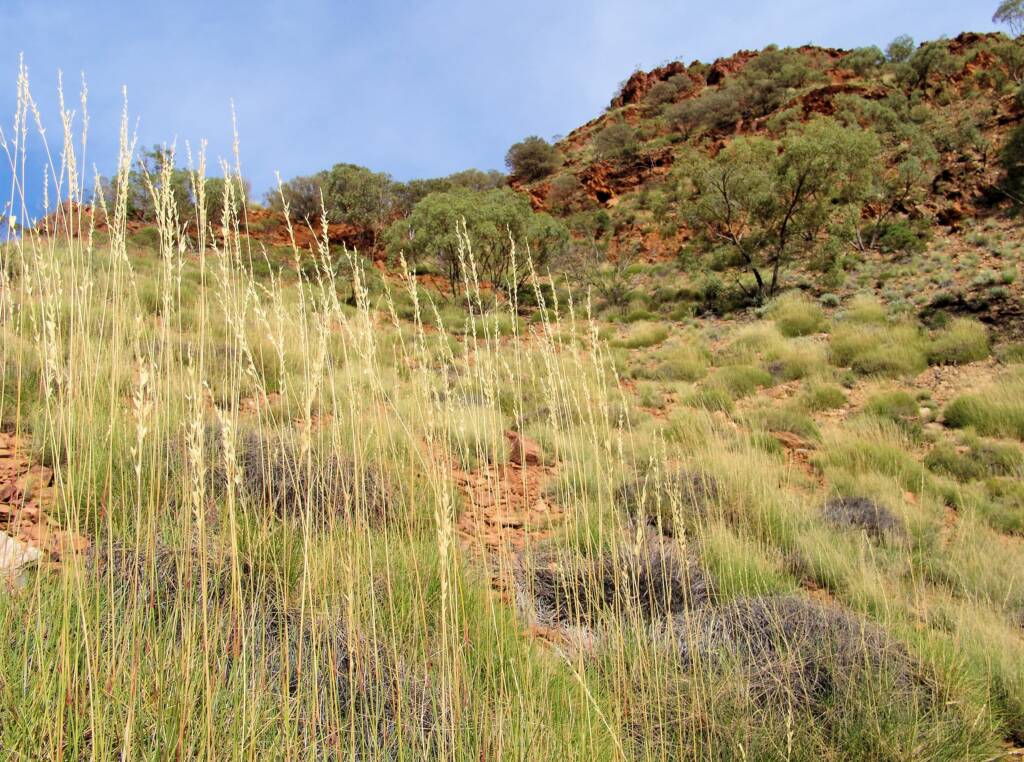
- Spinifex / Triodia schinzii, West MacDonnell Ranges, NT
- Hummock grassland – Spinifex / Triodia, West MacDonnell Ranges, NT
- Hummock grassland – Spinifex / Triodia, West MacDonnell Ranges, NT
Spinifex grasses can be divided into two groups known as ‘hard’ and ‘soft’ spinifexes.
The main difference is that the hard spinifex group does not contain resin, usually forming dense circular hummocks of rigid spiny leaves. They sometimes grow outwards with age into rings measuring 2-3 metres across, usually with a bare or dead centre.
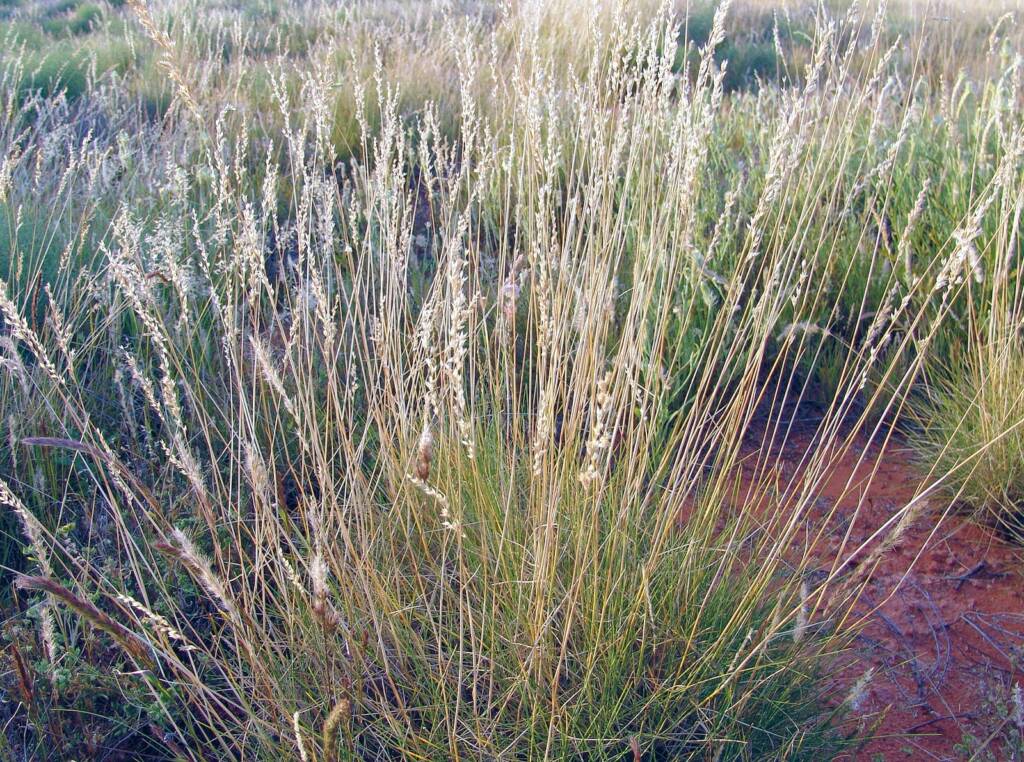
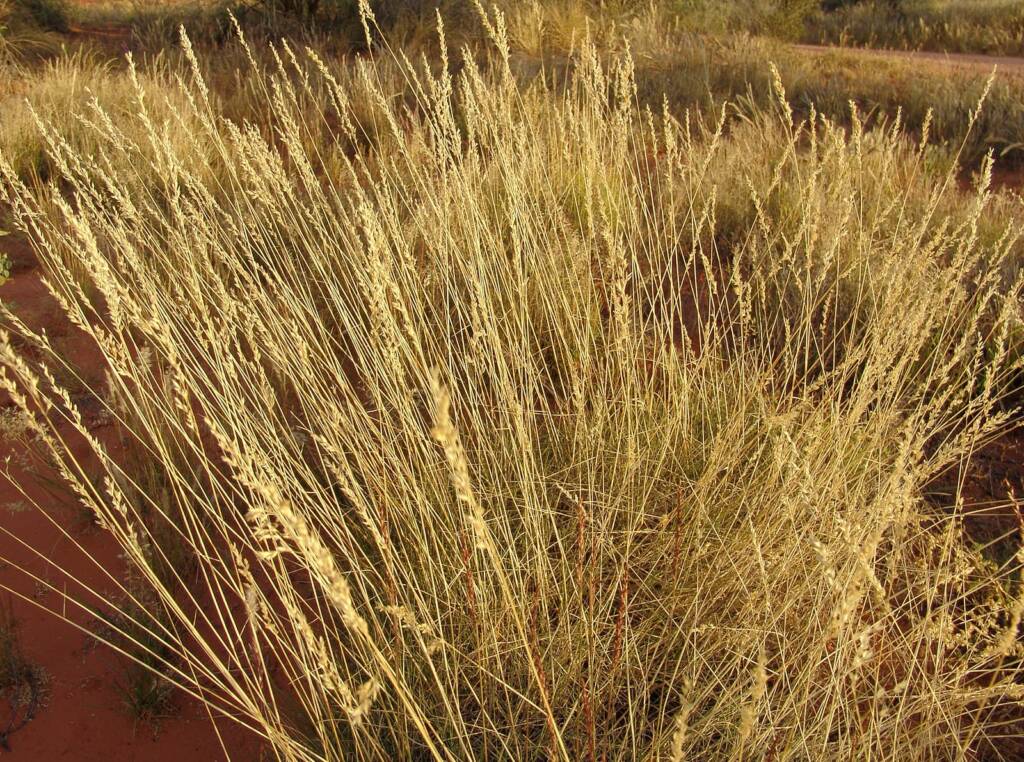
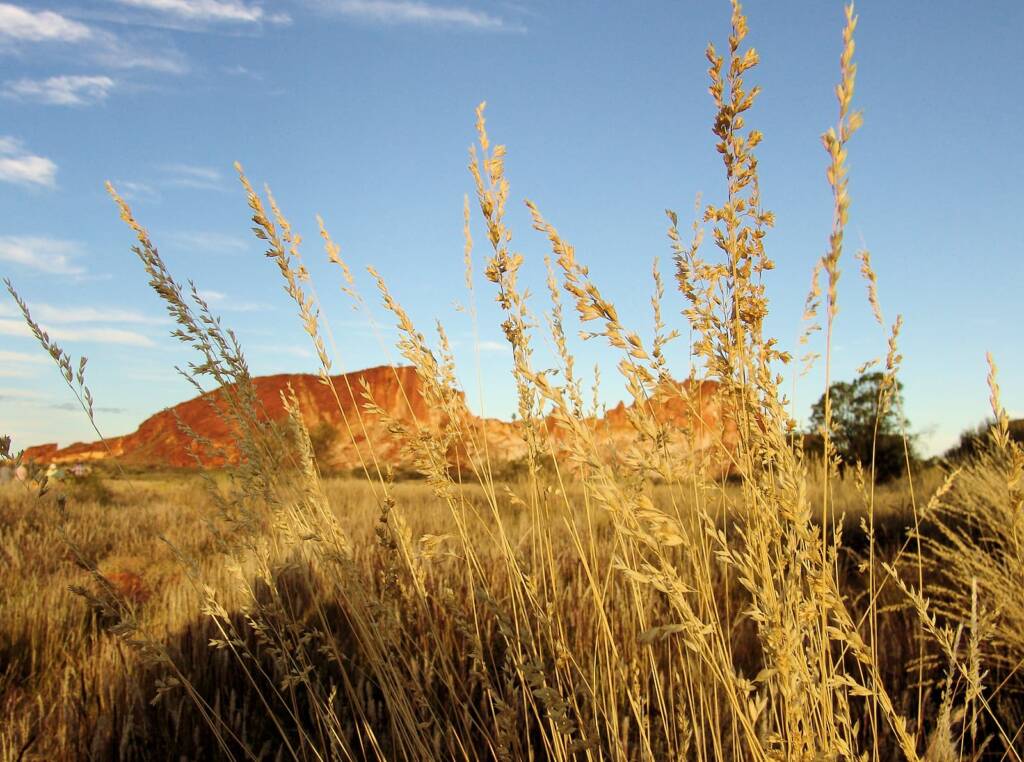
The soft spinifexes are less densely packed, have less spiny leaves and form a continuous cover like tussock grasses. They also frequently exude sticky resin from the stems and leaves, contributing to the intensity of some of the outback grass fires. The sticky resin also collect to the underside of motor vehicles that drive through this type of spinifex grass and have been known to cause the vehicles to catch alight under certain circumstances.
The young leaves of the spinifex are flat and relatively soft. However, as they age, they curl up lengthwise becoming a stiff, pointed spike.
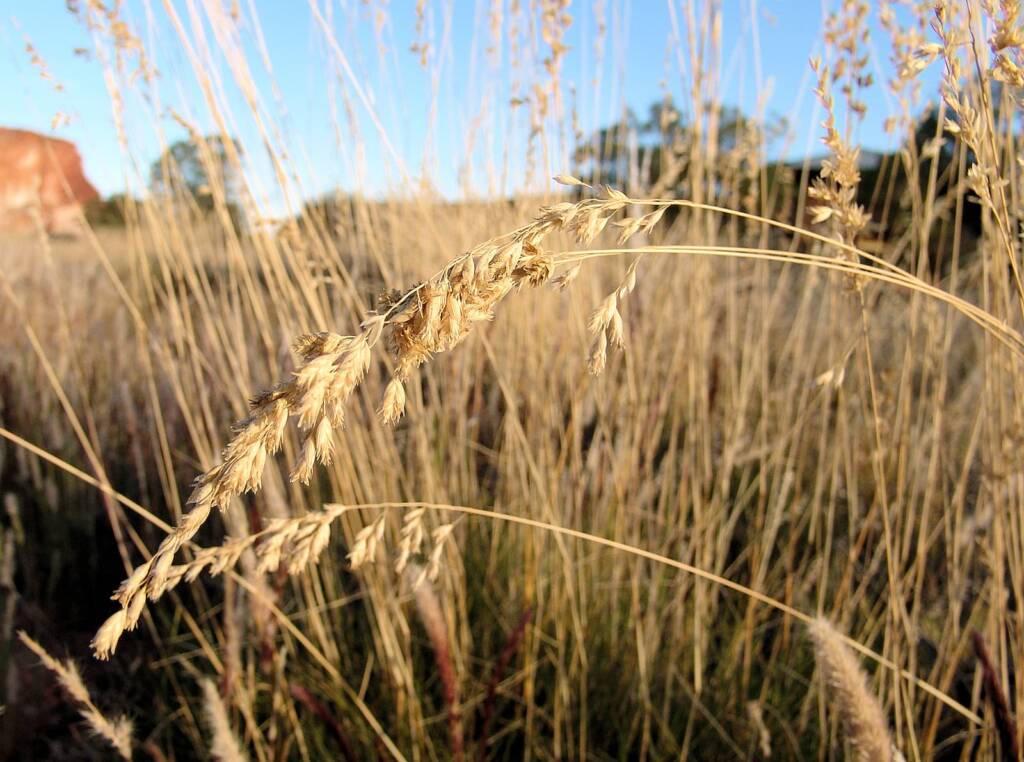
Spinifex provides for some interesting views, whether it totally dominates the landscape before you, or seeing a tussock of grass in front of you. Some provide interesting points of difference, straw coloured heads swaying gently in the breeze or tall standing grass of red coloured flower/seed heads.
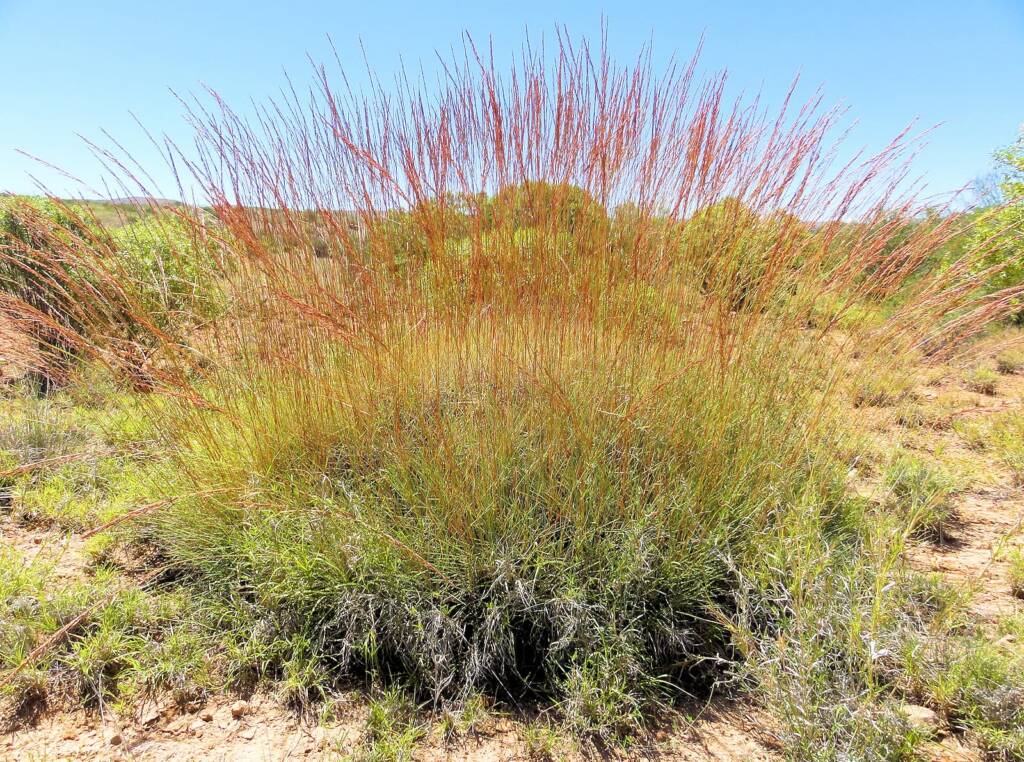
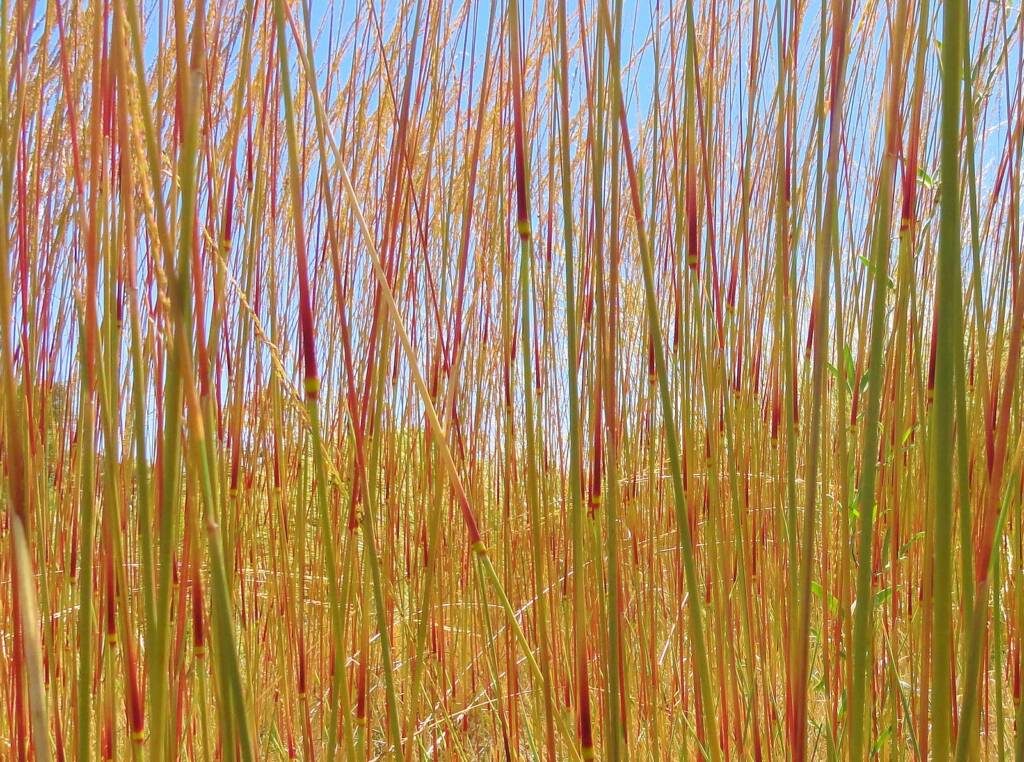
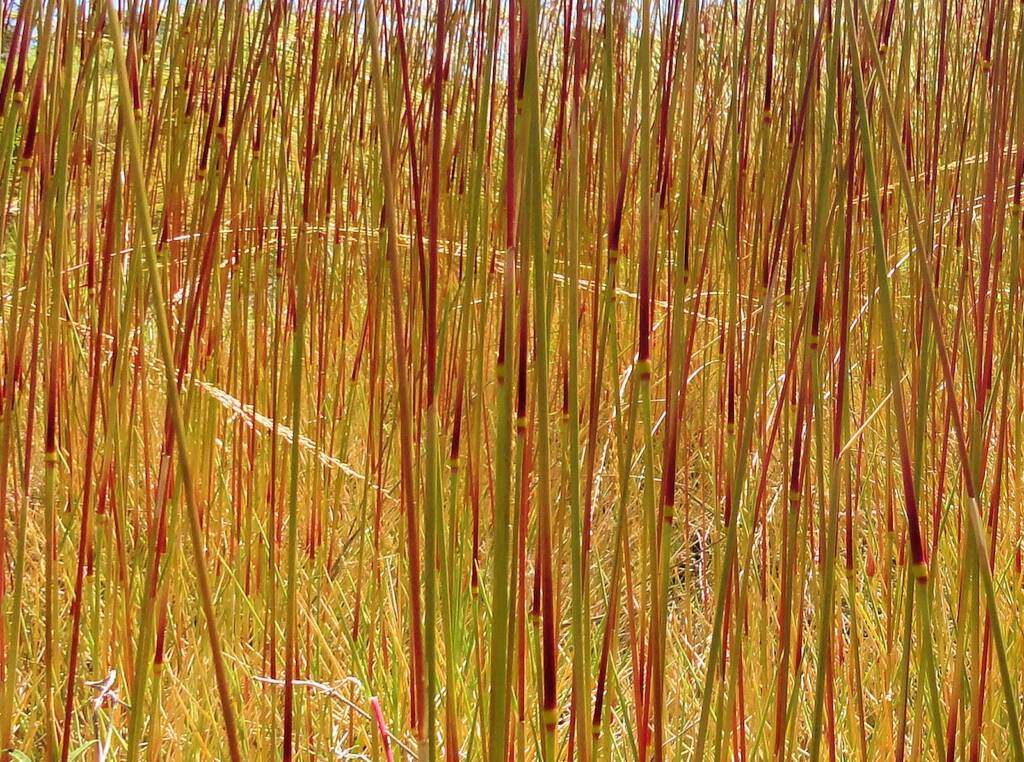
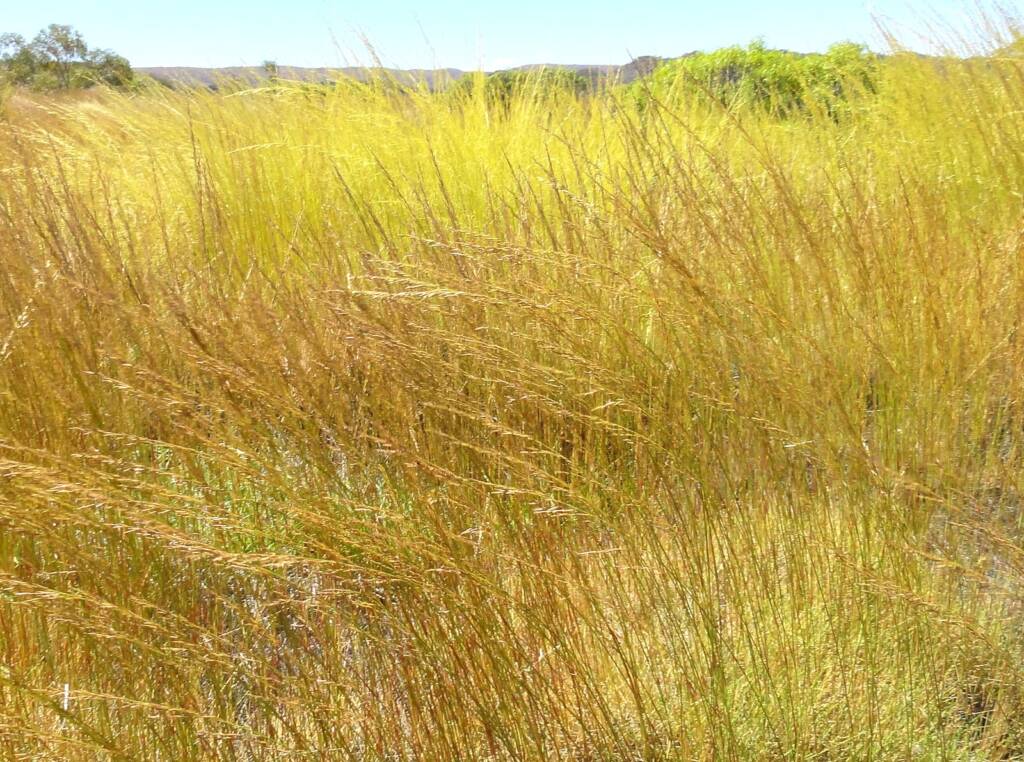
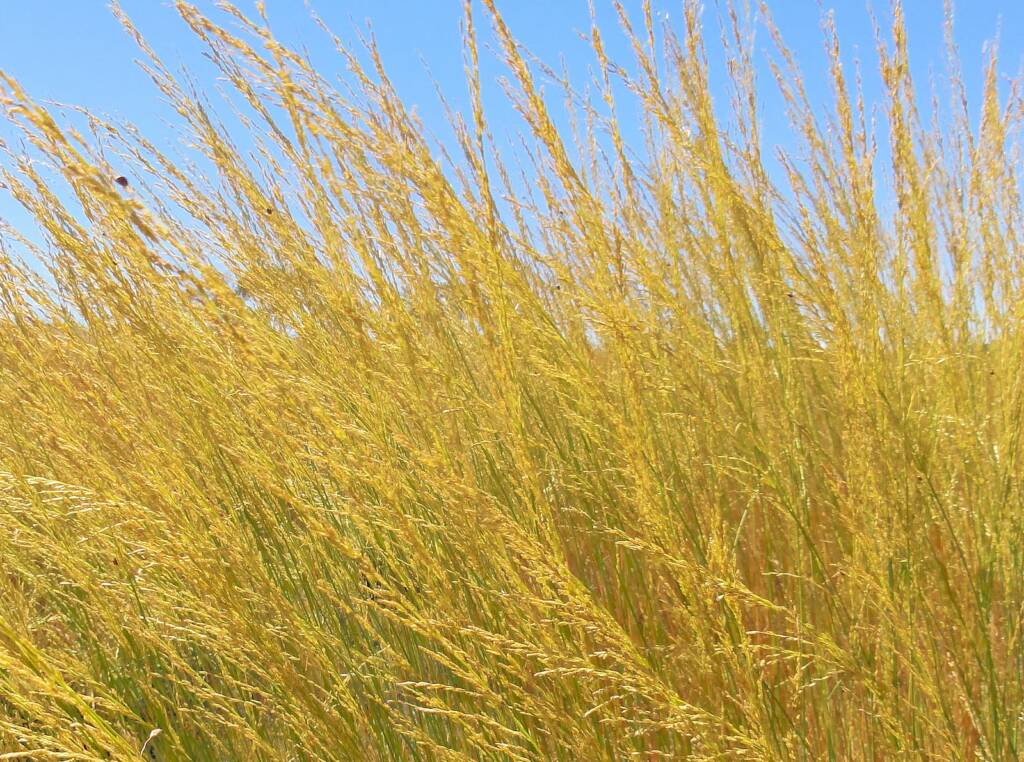
Spinifex Triodia brizoides
A compact tussock grass with leaves that grow to approximately 50 cm high with a pointed tip. This spinifex has flower/seed heads that rise out of the foliage to about 90 cm. The seed head has a loose and open form, that weeps or droops to one side with straw coloured seeds.
It is commonly known as Weeping Spinifex and can be seen at Wurre / Rainbow Valley. This spinifex is common throughout the West and East MacDonnell Ranges.
Spinifex and Fauna
The spiky spinifex that dominates 20% of the landscape in Australia, has an unfavourable rap sheet among many people that include sharp spikes and resin that cause vehicles to combust. The leaves contain a lot of silica, the same mineral that makes up the desert sand.
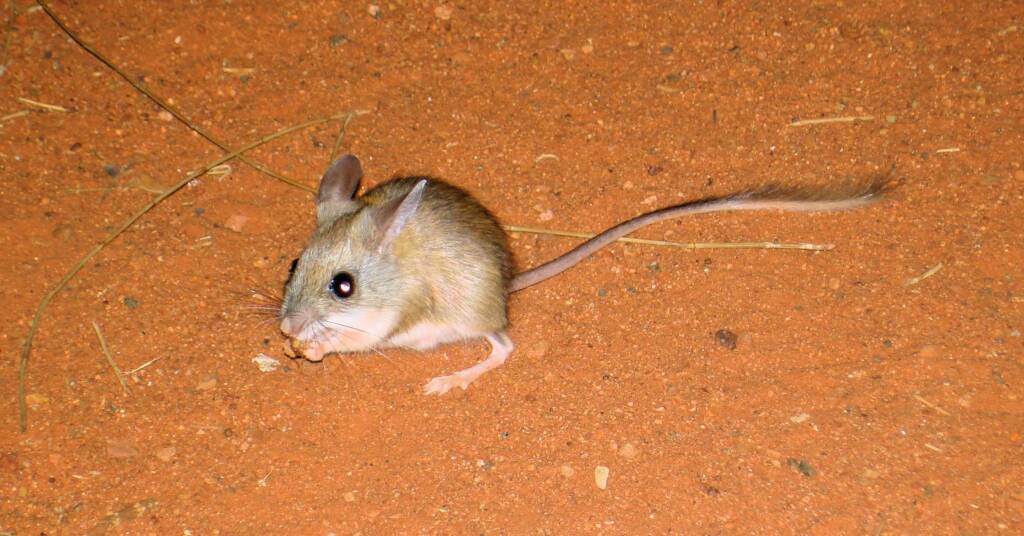
Yet there is another side to spinifex that provides a home to an astonishing number of creatures. It provide shelter, safety and food for many Australian creatures from the mallee emu wrens, spinifex hopping mice, the elusive night parrot, many striped Ctenotus skinks and the Spinifexbird, all using the spinifex to hide from predators, whilst snacking on insects that also shelter within.
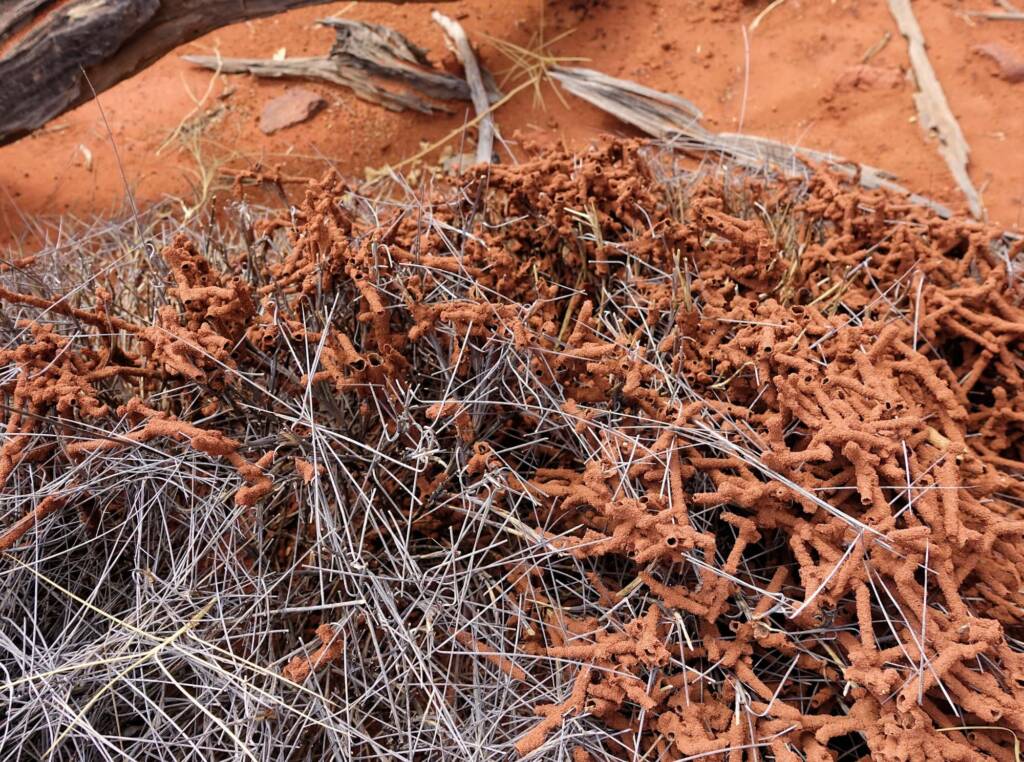
Termites are the main grazers of spinifex, which in turn provide food for other creatures.
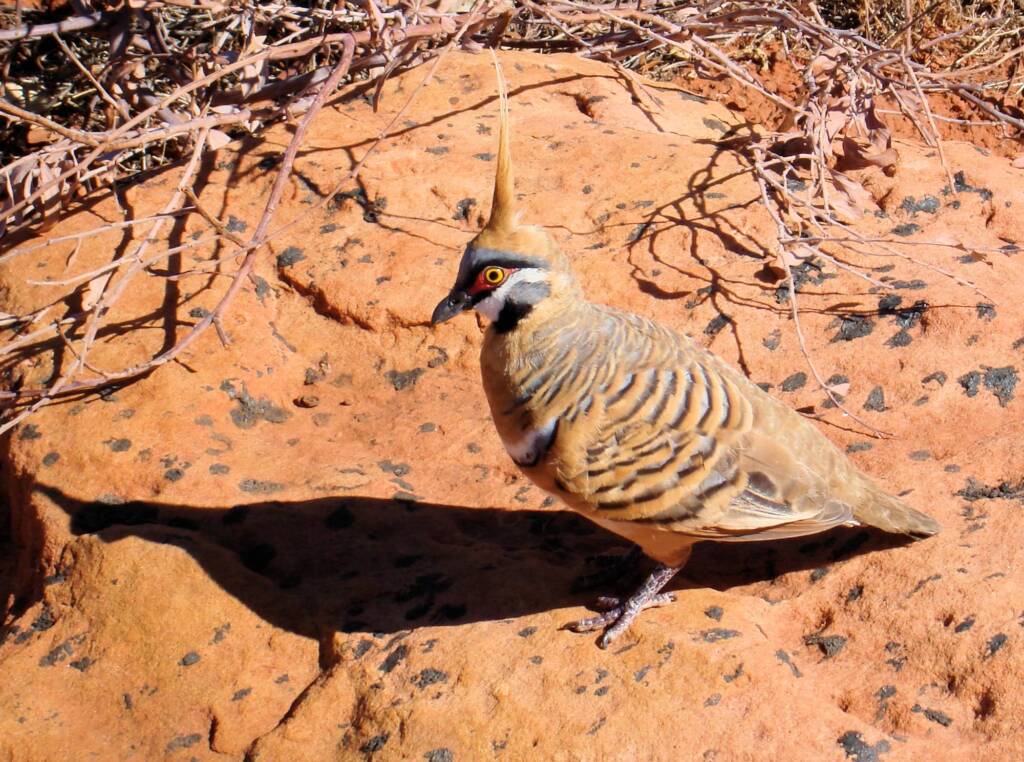
Birds including Budgerigars and Zebra Finches feed on the seed heads. The Spinifex Pigeon can be seen running around the spinifex, often eating the spinifex grass seeds.
Euros (Osphranter rufus erubescens) are one of the few native animals know to eat spinifex, with their specially adapted stomach sac that contain microorganism that help them to break down the tough leaves.
Check out our information on the Spinifex Hopping Mouse (Notomys alexis).
Aboriginal Use of Spinifex
Indigenous people have utilised spinifex for thousands of years and still use spinifex today, gathering the spinifex grass to extract the spinifex wax-like resin to use making waterproof thatching for shelter and windbreaks or as a hafting adhesive in crafting of tools and weapons such as knives and spears.
Hafting is a process by which an artifact, often made from bone, stone, or metal is attached to a haft (handle or strap).
As well as tools and weapons, spinifex resin was used in the making of personal adornment, used medicinally by medicine men, ceremonially and in objects of sorcery.
There is also evidence of spinifex resin and fibers being used for nets, meshes, baskets and sculptures, both traditionally and contemporary.
Known as tjanpi in Central Australia, the women of various Aboriginal Australian groups use spinifex for basket weaving.
Children were also known to use spinifex in a variety of play, including a bloodthirsty game of putting a drop of blood onto their thigh and any flies attracted to the blood was speared with the spine of the spinifex leaf. The one who speared the most flies in a given period won.
More in-depth and very interesting information can be found in the article The Point of Spinifex: Aboriginal uses of spinifex grasses in Australia by Heidi T. Pitman and Lynley A. Wallis2 and publication Bushfires & Bushtucker by Peter Latz3.
Spinifex and Fire
Fire and spinifex landscape is a fiery combination that was managed by the Indigenous people for thousands of years prior to European settlement. Scientific studies over the past decade and more, have shone considerable light and information on a practice that has and is now being reintroduced in many locations across Australia.
Spinifex Fire Ecology
Appendix 6 – Fire Strategy
…Fire regimes in the western deserts were actively managed by Aboriginal people for thousands of years, ending abruptly in the mid 1900s (Burrows and Christensen 1991). Desert people used fire continuously but with a high level of control, resulting in high density time-since-fire vegetation mosaics.4
There is a great number of online resources to read and learn more about spinifex and fire. Check out our footnotes below.
Spinifex in Aboriginal Art
When looking across at landscape and ranges that appear dotted with green spinifex, it can be imagined the influence of this upon the dotted artwork of many Aboriginal artists. Spinifex has been depicted in a variety of forms and styles, from the dots to the realistic depiction found in landscape works, and the sublime form of the minimalist works by the internationally renowned Dorothy Napangardi.
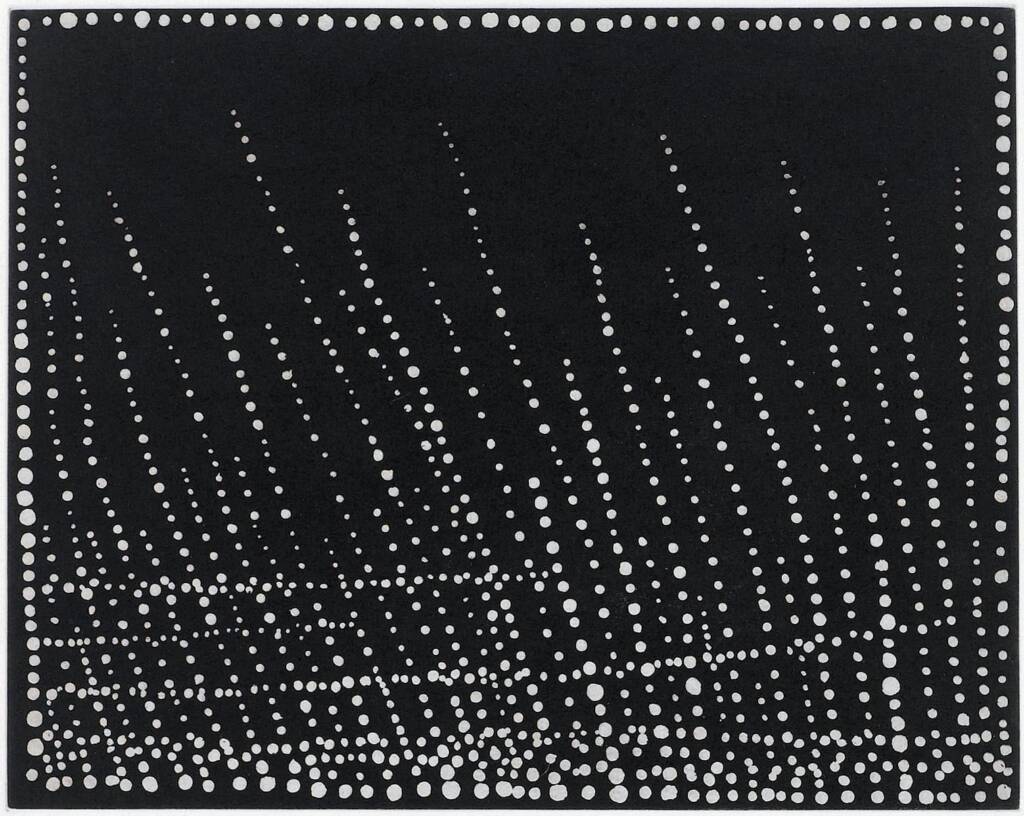
In this limited edition etching, the artist has created a striking white on black design depicting the giant spinifex (Triodia longiceps) that’s grows throughout the desert region, in the artist’s custodial country of Mina Mina located near Lake Mackay in the Tanami Desert, north of Yuendumu in the Northern Territory. These giant spinifex can grow taller than people. In this work, the artist depicts the ancestral women of the Napangardi and Napanangka (aunt / niece relationship) dancing across and through the spinifex, growing across the terrain and around the soakages of Mina Mina and the crustations that form when rainwater recedes.
Spinifex – Catalogue No: DN-4.1
Dorothy Napangardi © Gallery Gondwana
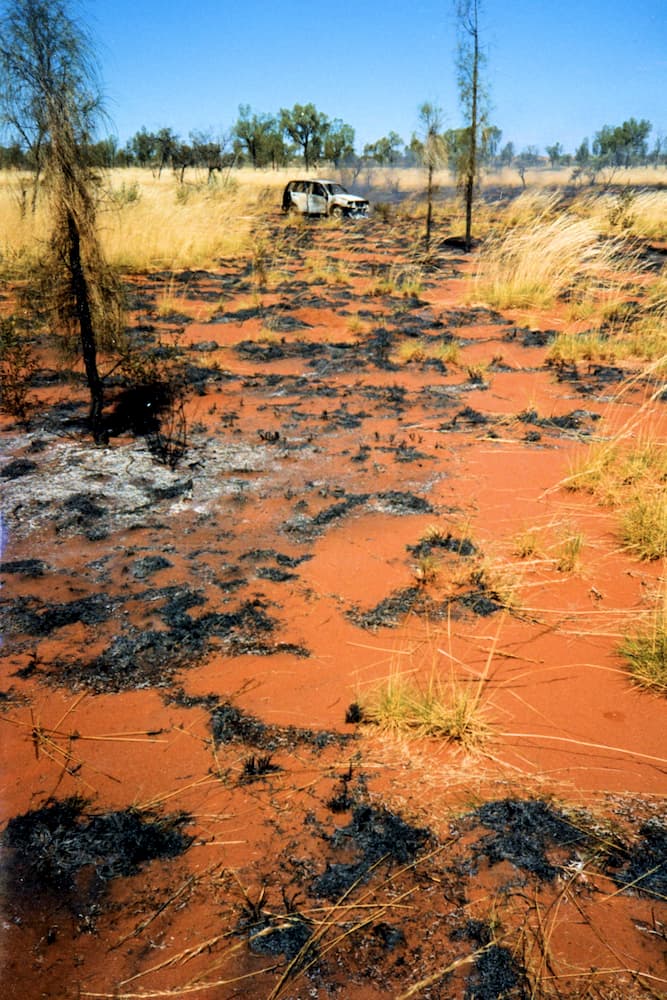
In 1999, Dorothy Napangardi finally achieved her dream of returning back home to ‘her borning place’ of Mina Mina – remote even for the Western Deserts of Australia. The convoy travelled through giant spinifex (Triodia longiceps) that were taller then the vehicles.
Just before we arrived at Mina Mina, we took a wrong turn and ploughed through yet more spinifex. Dorothy and I were up front in the convoy with 3 aunties in the back when she asked me to stop as she could see fire behind us from her side mirror. To our horror we realised one of the vehicles was alight…
Dorothy Napangardi: Honouring and Remembering the Art and Life of Dorothy Napangardi 1987-2013
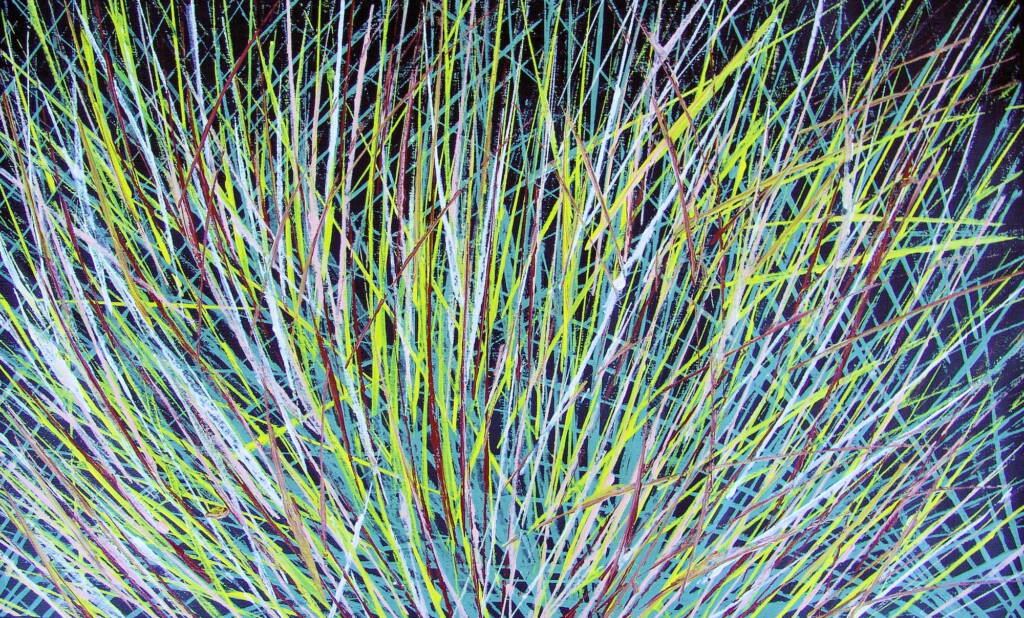
The Spinifex Art Project
is a collective of Pitjantjatjara aboriginal artists, male and female. The Pitjantjatjara Aboriginal people, also known as the Spinifex People are from the desert community of Tjuntjuntjara. They were dispossessed from their homelands in the Great Victorian Desert in the 1950s during a time when their country was taken over for the Maralinga Atomic testing that was carried out between 1952 and 1957 by the British and Australian governments.
Tjuntjuntjara was a newly selected outstation camp in the south-western corner of the Spinifex homelands. In 1992 the High Court of Australia gave recognition to Native Title, a process that lead to the Aboriginal people of the Spinifex country being handed title to their homelands in November 2001.
The Spinifex Arts Project was initiated in 1996 as part of the process of documenting the connection between the Spinifex People and their land.
Tjuntjuntjara Community — www.spinifex.org.au
- Scientific classification
- Kingdom: Plantae
- Clade: Tracheophytes
- Clade: Angiosperms
- Clade: Monocots
- Clade: Commelinids
- Order: Poales
- Family: Poaceae
- Subfamily: Chloridoideae
- Tribe: Cynodonteae
- Subtribe: Triodiinae
- Genus: Triodia
Related topics: Spinifex hopping mouse (Notomys alexis); Spinifex Pigeon (Geophaps plumifera)
Footnote & References
- Hansjörg Eichler Scientific Research Fund Report – Leaf blades or floral clades – A guide to spinifex phylogeny by Jim Mant, Australian National University, Retrieved August 29, 2008
- The Point of Spinifex: Aboriginal uses of spinifex grasses in Australia by Heidi T. Pitman and Lynley A. Wallis
- Bushfires & Bushtucker: Aboriginal Plant Use in Central Australia by Peter Latz; IAD Press
- Spinifex Fire Ecology, Appendix 6 – Fire Strategy; Fire Management and Monitoring Strategy, April 2019
- Fire regimes in the spinifex landscapes of Australia, January 2002, Grant E Allan, Parks and Wildlife Commission; Richard Southgate, University of Adelaide
- Traditional and contemporary fire patterns in the Great Victoria Desert, Western Australia, May 2018; Final Report Great Victoria Desert Biodiversity Trust Project GVD-P-17-002; Neil Burrows and Jane Chapman
- Fire regime (recency, interval and season) changes the composition of spinifex (Triodia spp.)-dominated desert dunes, Boyd R. Wright and Peter J. Clarke, Australian Journal of Botany, 2007, 55, 709–724; CSIRO Publishing
SpinifexSoft Spinifex (Triodia pungens) Weeping Spinifex (Triodia brizoides)
Grass and GrassesBirdwood Buffel (Cenchrus setiger) Buffel Grass (Cenchrus ciliaris) Fairy Grass (Sporobolus caroli) Finger Grass (Chloris barbata) Kangaroo Grass (Themeda triandra) Silkyheads (Cymbopogon obtectus) Wanderrie Grass (Eriachne sp)