Sturt’s Desert PeaSturt’s Desert Pea, northern Sturt’s Desert Pea, pink Sturt’s Desert Pea, white
Floral Emblem of South Australia
Swainsona formosa is one of Australia’s most recognisable prostrate ground covering plants, growing between 30-40 cm high and able to cover several square metres of ground. The Sturt’s Desert Pea is a member of the pea family, Fabaceae and was included in the original collection made in 1699 by William Dampier on Rosemary Island in the Dampier Archipelago (off the north-western coast of Australia) where he collected a specimen from:
“a creeping vine that runs along the ground… and the blossom like a bean blossom, but much larger and of a deep red colour looking very beautiful”
Source: William Dampier
The specimen, now housed in the Sherardian Herbarium, Oxford, was for many years included in the genus Clianthus and known as Clianthus formosus. It has since been reclassified and placed in the genus Swainsona (after Isaac Swainson, a scientist and plant cultivator). Formosa is the Latin formosus, for beautiful, hence the species Swainsona formosa.
The plant is more commonly known as “Sturt’s Desert Pea” after explorer Captain Charles Sturt, who noted the occurrence of Swainsona formosa in 1844 while exploring between Adelaide and Central Australia. Sturt’s journal “Narrative of an Expedition into Central Australia” makes several references to the beauty of the desert pea in flower and the harsh nature of its habitat.
Habitat: Sturt’s Desert Pea occurs in all mainland states except Victoria and has also been seen growing in the southern most part of the Northern Territory. It is found growing in red-brown sandy or loamy soils on open plains, mulga shrubland and the desert regions of Central Australia. It is found mainly in areas where there is no grazing of livestock as the plant is eaten by cattle.
The plant can be seen growing as cultivated plantings in Alice Springs, Alice Springs Desert Park, and Olive Pink Botanic Garden. Many botanic gardens may also have cultivated plants on display of the Sturt’s Desert Pea.
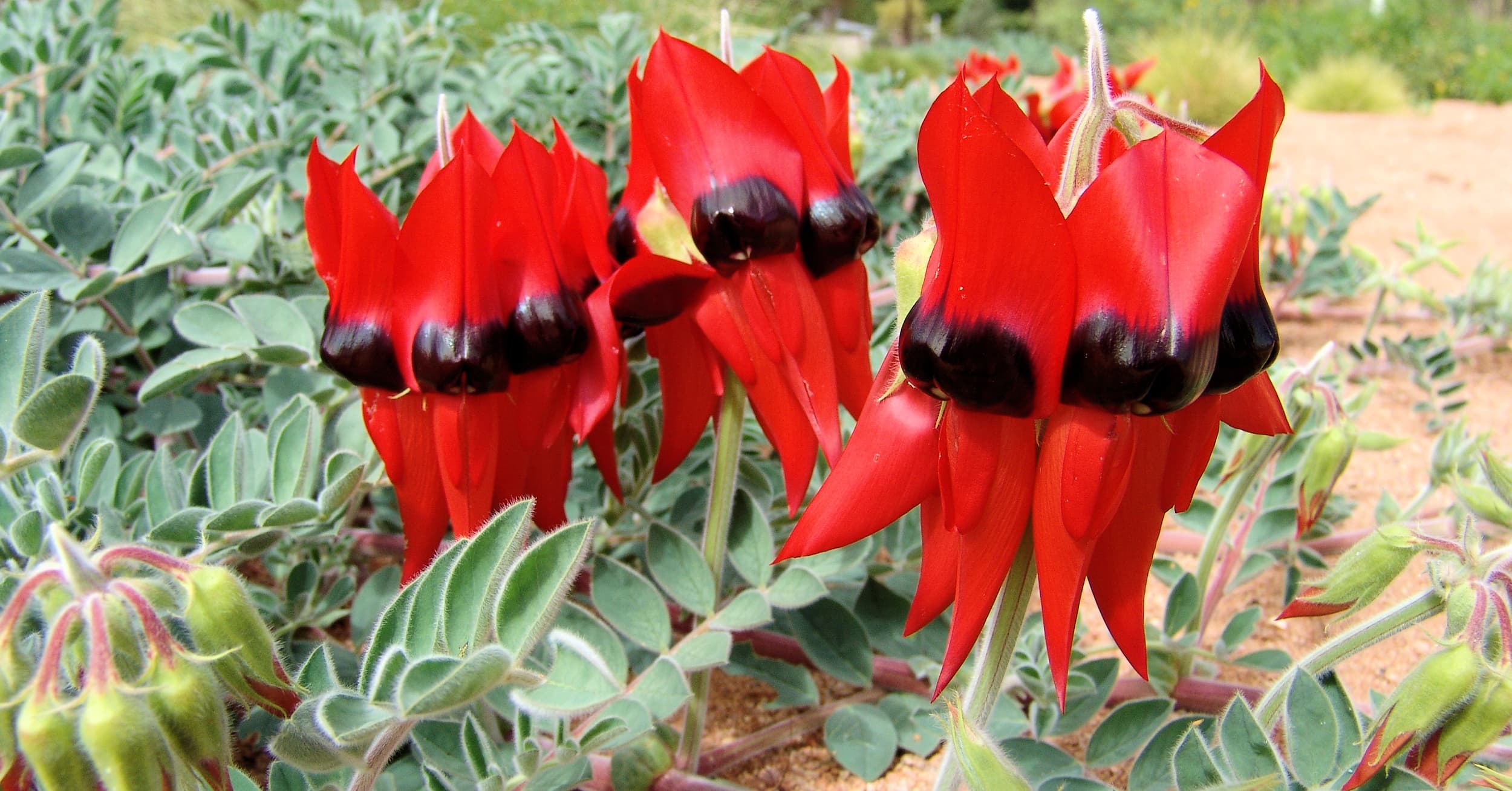
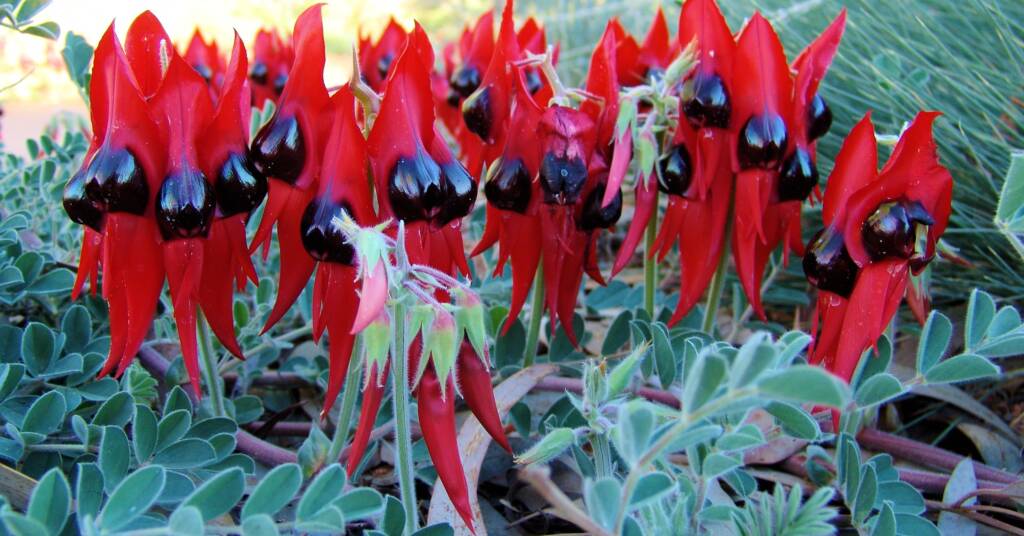
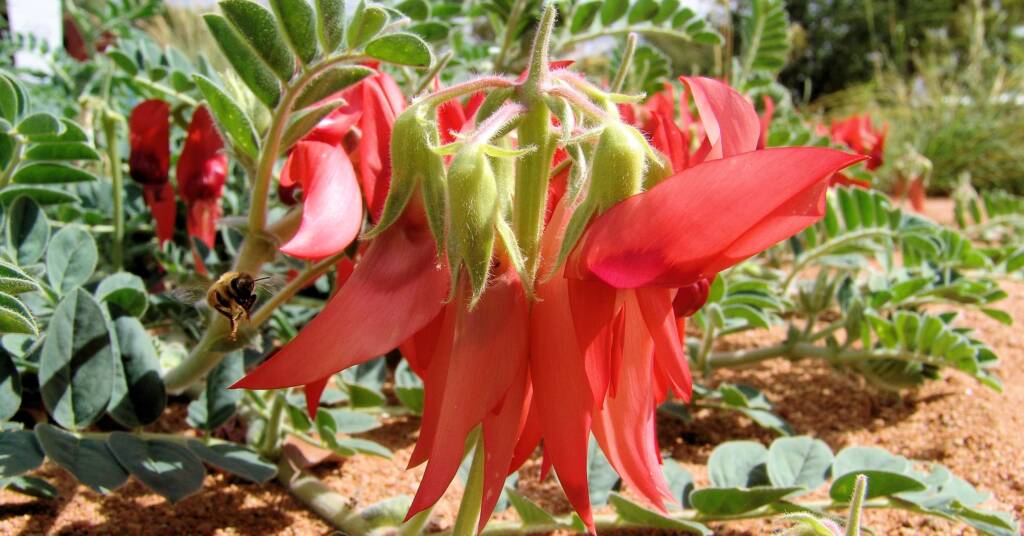
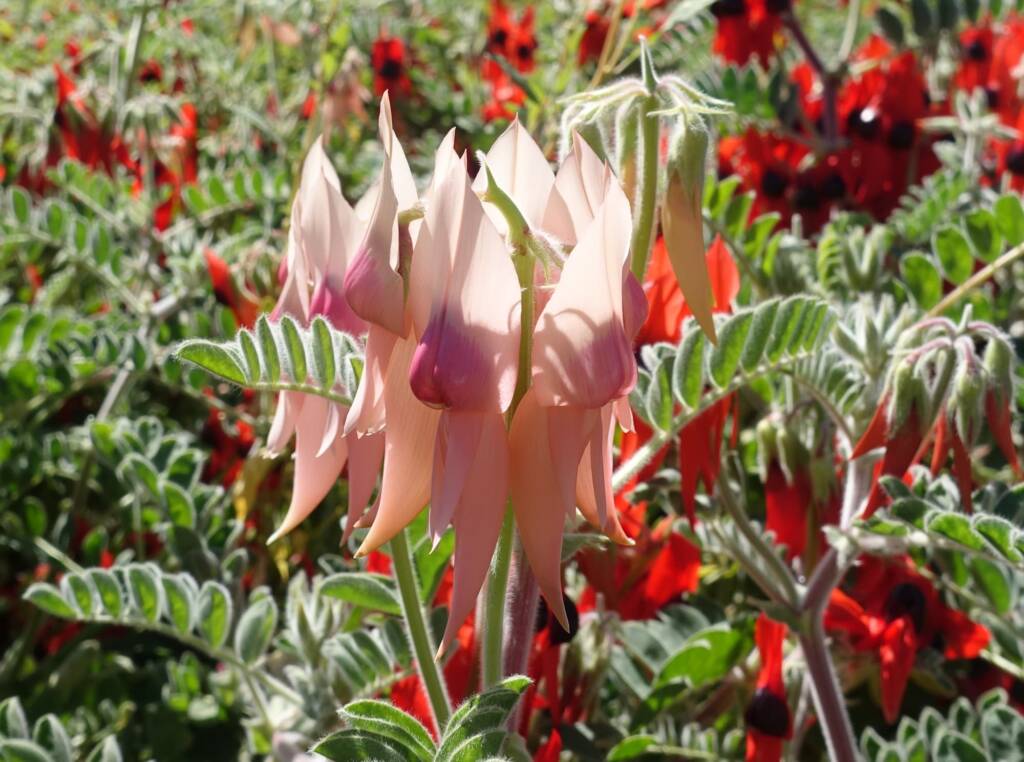
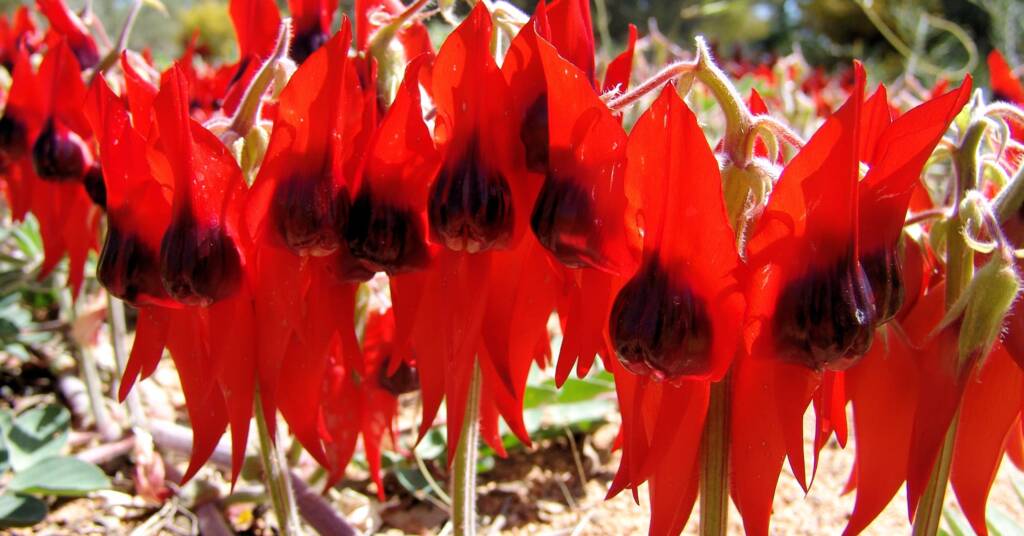
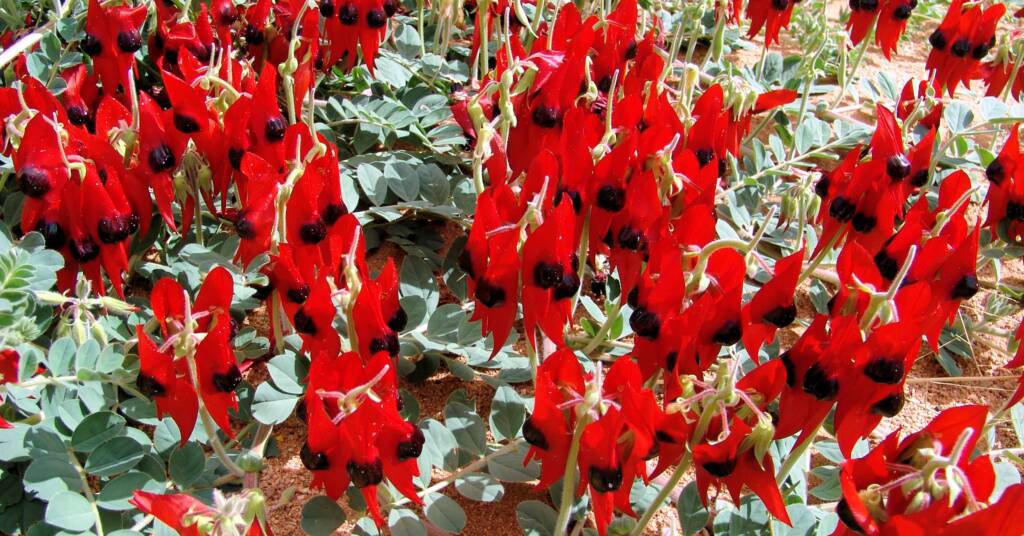
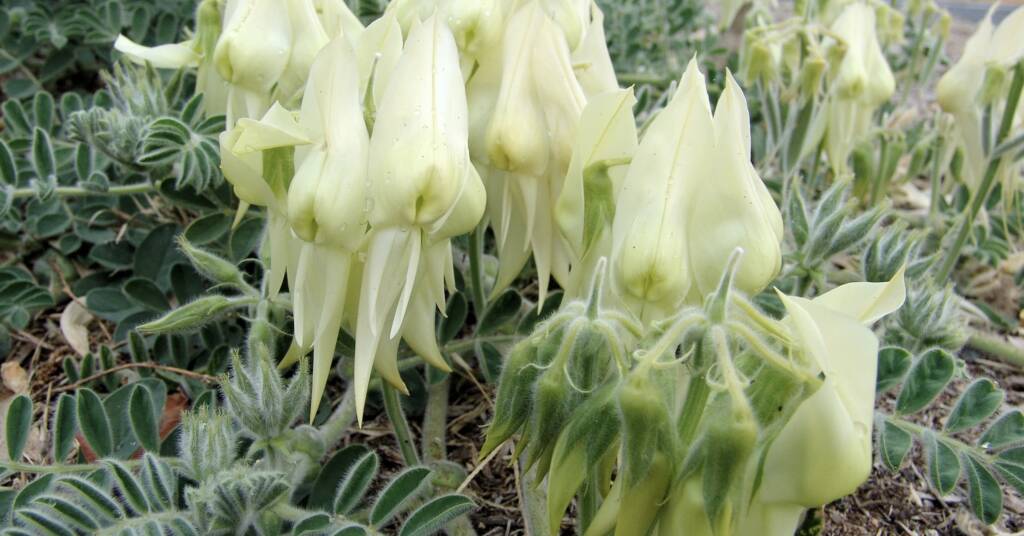
Description: In its natural habitat, Sturt’s Desert Pea is a perennial plant with an almost silky grey-green pinnate foliage which grows prostrate spreading across the ground, that has erect flower clusters. There are two recognised forms – the inland form with a black boss, and the northern form, with a pale red boss. Other naturally occurring hybridisation within the species have given rise to plants with a pure white, pale pink, apricot and bicolours flower, with or without the black boss.
Leaves: Close examination shows that the leaves and stems are covered with downy hairs. The leaves pinnate with about 13-15 hairy leaflets, that decrease in size towards the apex.
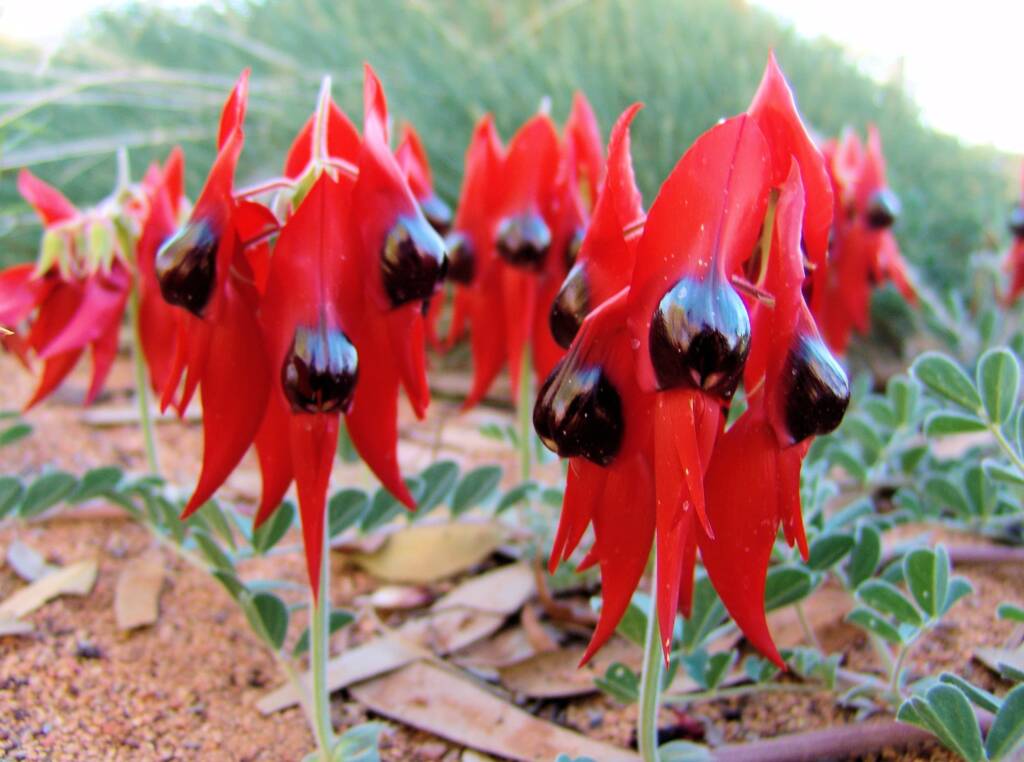
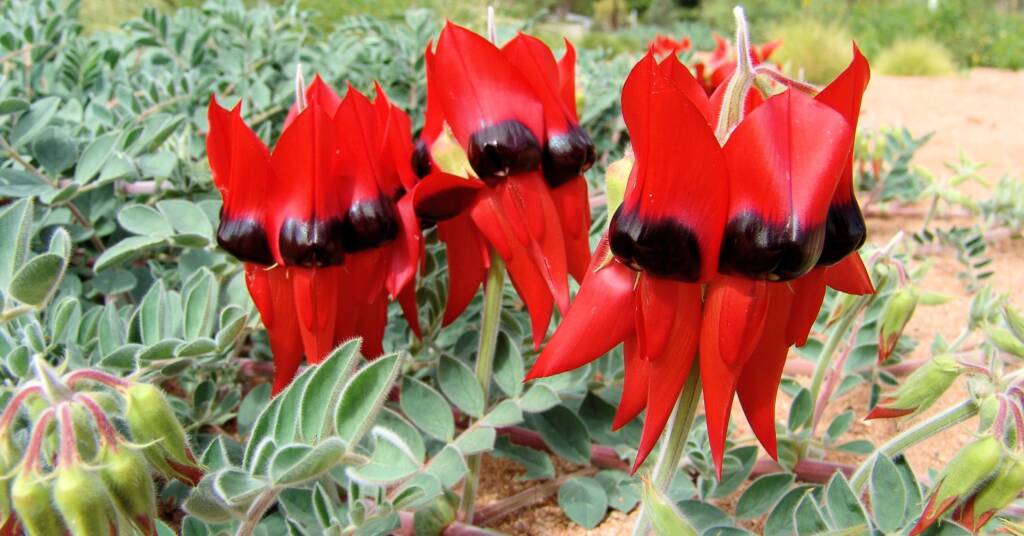
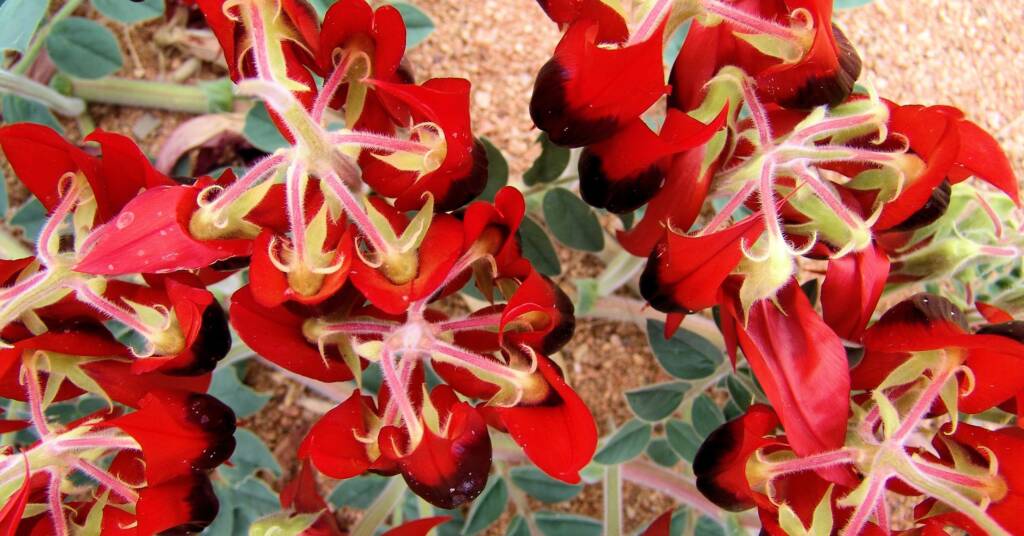
Flowers: The flowers are usually arranged in a clusters of three to eight on a thick, short, erect stalks. The flower itself are about 9 cm from tip to tip and is usually a blood red or scarlet. A variation to the colour range from white to deep pink. The standard petal is pointed upwards and has a shiny black, sometimes red or pale dome (“boss”) at the base. The keel is the same length and points downwards. There are two small “wings” petals below the boss pointing in the same direction as the keel.
Fruit: The narrowly ellipsoid pods swell and are about 10-12 mm in length. The flowers are bird-pollinated in the wild, producing a legume about 5 cm long filled with seeds.
Sturt’s Desert Pea was adopted as the floral emblem of South Australia on 23rd November, 1961, using the name Clianthus formosus.
Aboriginal Dreamtime: There are a number of stories about the Sturt’s Desert Pea from Aboriginal Dreamtime, the saddest being about two young people from different tribes, who were in love. The flowers are known to the Aboriginal people as ‘Flowers of Blood‘.
- Common name
- Sturt’s Desert Pea, Flowers of Blood, Floral Emblem of South Australia.
- Where Found
- The natural habitat for the Sturts Desert Pea habitat ranges from Karratha on the Western Australia coast, across Central Australia and north of Alice Springs in the Northern Territory, down south to the northern half of South Australia, the south-west part of Queensland and western part of New South Wales.
Check out our other images of the:
Images © Ausemade PL
- Scientific Classification
- Kingdom: Plantae
- Division: Magnoliophyta
- Class: Magnoliopsida
- Order: Fabales
- Family: Fabaceae
- Subfamily: Faboideae
- Tribe: Galegeae
- Genus: Swainsona
- Species: Swainsona formosa
Footnote & References
- Swainsona formosa (G.Don) Joy Thomps., Atlas of Living Australia, https://bie.ala.org.au/species/Swainsona formosa
- Sturt’s Desert Pea (Swainsona formosa), iNaturalistAU, https://inaturalist.ala.org.au/taxa/85367-Swainsona-formosa
- Sturt’s mutated Desert Peas, by Kendall Jackson, 26 October 2010, ABC Local, https://www.abc.net.au/local/photos/2010/10/22/3045488.htm (this link is no longer active)
Sturt’s Desert PeaSturt’s Desert Pea, northern Sturt’s Desert Pea, pink Sturt’s Desert Pea, white
FloraFlora in Australia Flora Index Acacia Adenanthos cuneatus (Coastal Jug Flower) Agapanthus Apium prostratum subsp. prostratum var filiforme Anigozanthos (Kangaroo Paws) Apple Bush (Pterocaulon sphacelatum) Annual Yellowtop Australian Bluebell Australian Gossypium Banksia Batswing Coral Tree Billy Buttons Birdsville Indigo Blue Pincushion Bush Banana Callistemon Callitris drummondii (Drummond’s Cypress Pine) Calothamnus quadrifidus Cape Honeysuckle Cassia fistula (Golden Shower) Cattle Bush Common Heath Crotalaria Darwinia wittwerorum (Wittwer’s Mountain Bell) Daviesia oppositifolia (Rattle-pea) Desert Oaks Drumsticks Eremophila Eucalyptus Ficus Flannel Cudweed (Actinobole uliginosum) Georges Indigo Goatshead Burr (Sclerolaena bicornis) Golden Everlasting Goodenia Gossypium Grass and Grasses Grass Trees Grevillea Grey Germander Hakea Kapok Bush (Aerva javanica) Lambertia sp Leptospermum MacDonnell Ranges Cycad Maireana scleroptera Mexican Poppy Minnie Daisy Mistletoe Family Nardoo Native Apricot Nicotiana megalosiphon subspecies sessilifolia Nuytsia floribunda Orange Spade Flower Orchidaceae Parakeelyas (Calandrinia) Pebble Bush (Stylobasium spathulatum) Perennial Yellow Top Pink Everlasting Pink Rock Wort Poached Egg Daisy Portulaca Proteaceae Ptilotus Quandong Resurrection Fern Rosy Dock Ruby Saltbush Santalum Solanum Spike Centaury Spinifex Storkbill (Erodium cygnorum) Striped Mint Bush Sturt’s Desert Pea Sturt’s Desert Rose Tall Saltbush Tangled Leschenaultia Tar Vine Tribulus eichlerianus Upside-down Plant Urodon dasyphylla Variable Daisy Waratah (Telopea) Wertabona Daisy White Cedar (Melia azedarach) White Indigo White Paper Daisy Wild Passionfruit Wild Stock Woolly-Headed Burr Daisy Woolly Bush Yellow-keeled Swainsona
Flora & FaunaFauna Flora Fauna Flora Funga Glossary Funga Related Topics Scientific Classification Backyard Wildlife Floral Emblems of Australia Wildflowers