
EucalyptusEucalyptus Index Corymbia aparrerinja (Ghost Gum) Eucalyptus camaldulensis (River Red Gum) Eucalyptus erythrocorys (Red-capped Gum) Eucalyptus gamophylla (Blue Mallee) Eucalyptus infera (Durikai Mallee) Eucalyptus orbifolia (Round Leaf Mallee) Eucalyptus lehmannii subsp. parallela Eucalyptus pachyphylla (Red-bud Mallee) Eucalyptus platypus (Coastal Moort) Eucalyptus woodwardii (Lemon-flowered Gum)
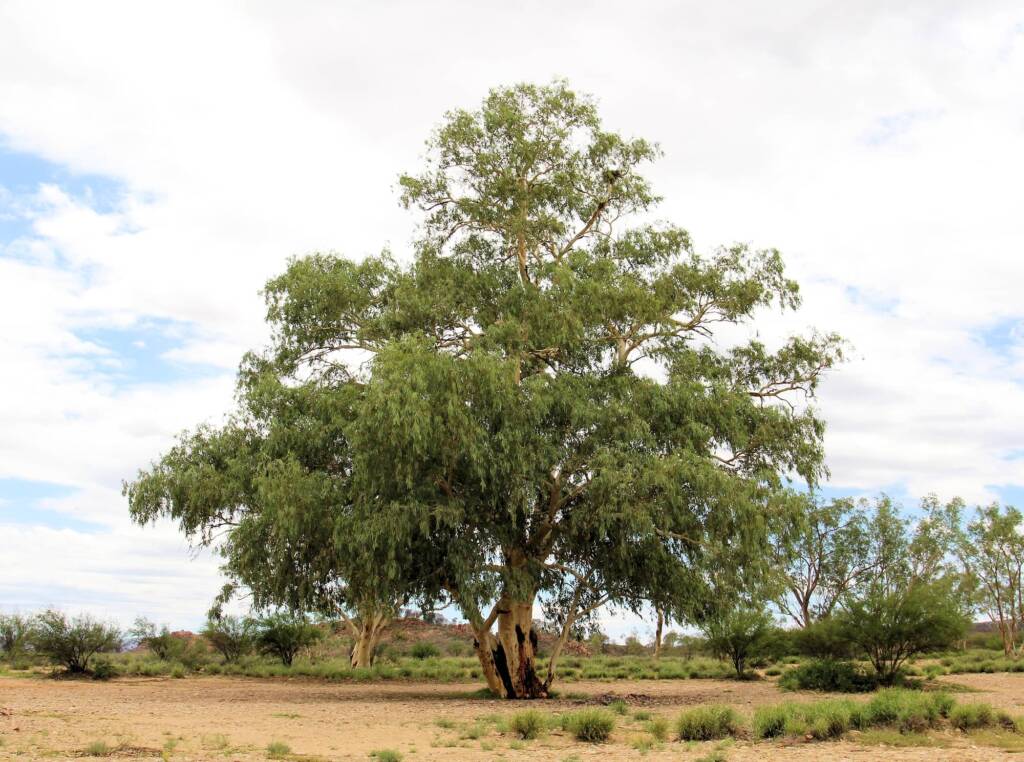
The Eucalyptus are a genus of over several hundred species of flowering trees, shrubs or mallees in the myrtle family, Myrtaceae. Together with several other genera in the tribe Eucalypteae, including Corymbia, they are commonly known as eucalypts.
All eucalypts are not Eucalpytus, as the term ‘eucalpyt’ refers to three closely-related genera of the family Myrtaceae – that includes Eucalyptus (approximately 758 species), Corymbia (approximately 93 species) and Angophora (approximately 10 species). All together, they are colloquially commonly called ‘gum trees’.
Eucalypt Discover Walk, Australian National Botanic Gardens, https://www.anbg.gov.au/gardens/visiting/exploring/walks/eucalypt-walk/
Most eucalypts are native to Australia, with three-quarters of Australian forests being eucalypt forests (although with continual land clearance this is changing). Whilst most eucalypt species are adapted to fire (re-sprouting after the fire and seeds that can survive fire), it is highly likely that with the high-intensity fires of recent times and repeated fires, this environmental and climatic change may prove a challenge for the natural regeneration of eucalypts.
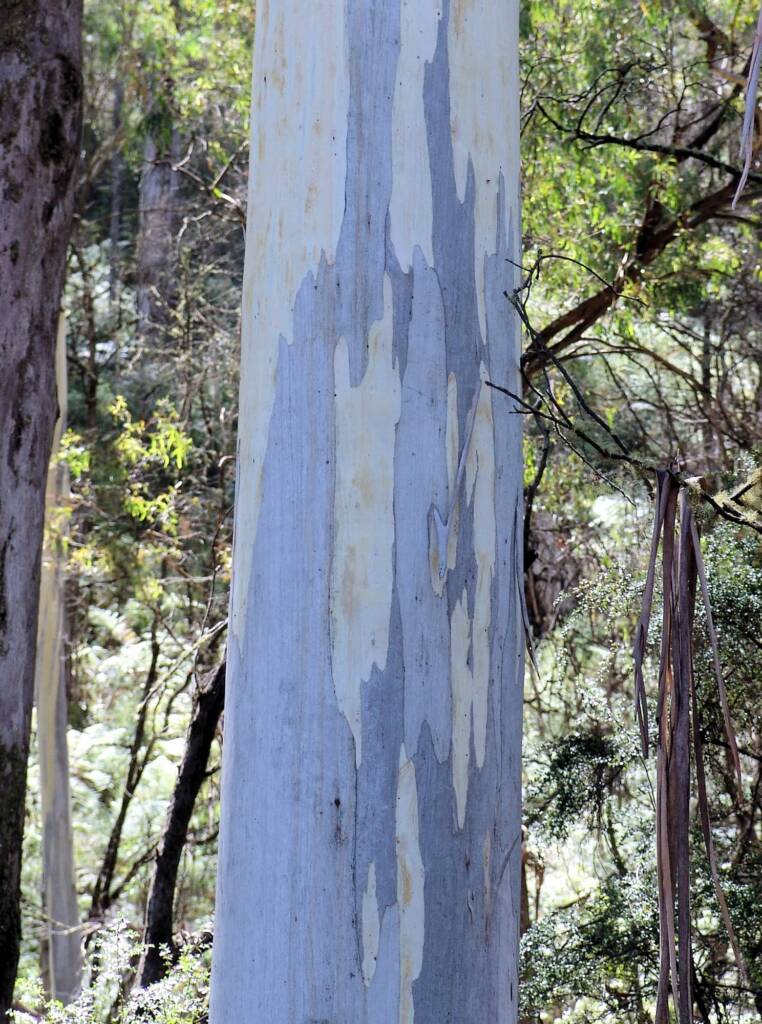
The genus Eucalyptus have bark that can be smooth, fibrous, hard or stringy. The leaves have oil glands that can often be smelt as you approach or stand near the tree, especially on warm days or within a eucalypt forest.
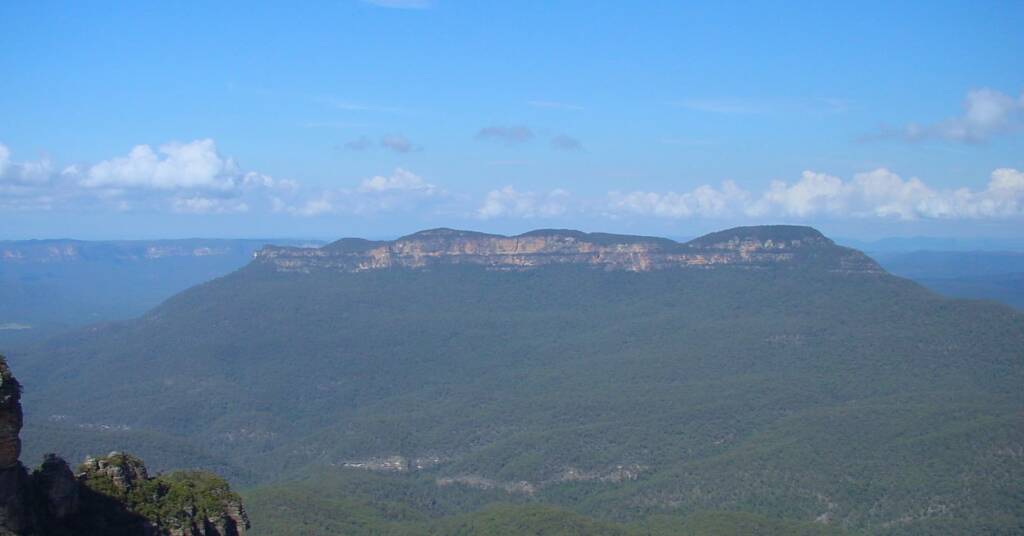
The Blue Mountains of New South Wales, when viewed from a distance appears to have a blue haze blanket the region. The region is densely covered with eucalyptus and gum trees growing in the area (there being four main types of eucalyptus trees that cover the regions hills, mountains, canyons, valleys and plateaus). As a consequence, the eucalyptus forests in this region emit huge amount of oils into the atmosphere. It is thought, that the eucalyptus oils, dust particles, and water vapour combine, and as the sunlight hits this atmosphere, it creates an optical illusion of a blue haze. The light allowing the eyes to see the blue pigments in the atmosphere. However, there is another theory
the sky is blue because tiny air molecules of oxygen and nitrogen, water molecules, and dust motes interact with light. The small size of these particles means that high-frequency light (like, blue) is much more likely to interact than low-frequency light (such as red). The interaction scatters blue light in all directions. Consequently, we are more likely to see blue light than any other colour. Thus, the sky looks blue.
Consequently, distant dark mountains reflect little light to our eyes. Our eyes receive much more light from sunlight scattered by tiny molecules between us and the mountain. That scattered sunlight is blue. So, it isn’t a scattering of light reflected from the mountain that makes the mountain appear blue, but rather a scattering of light between us and the mountain. (WeatherQuesting Web Site)
Blue Mountains Association of Cultural Heritage Organisations
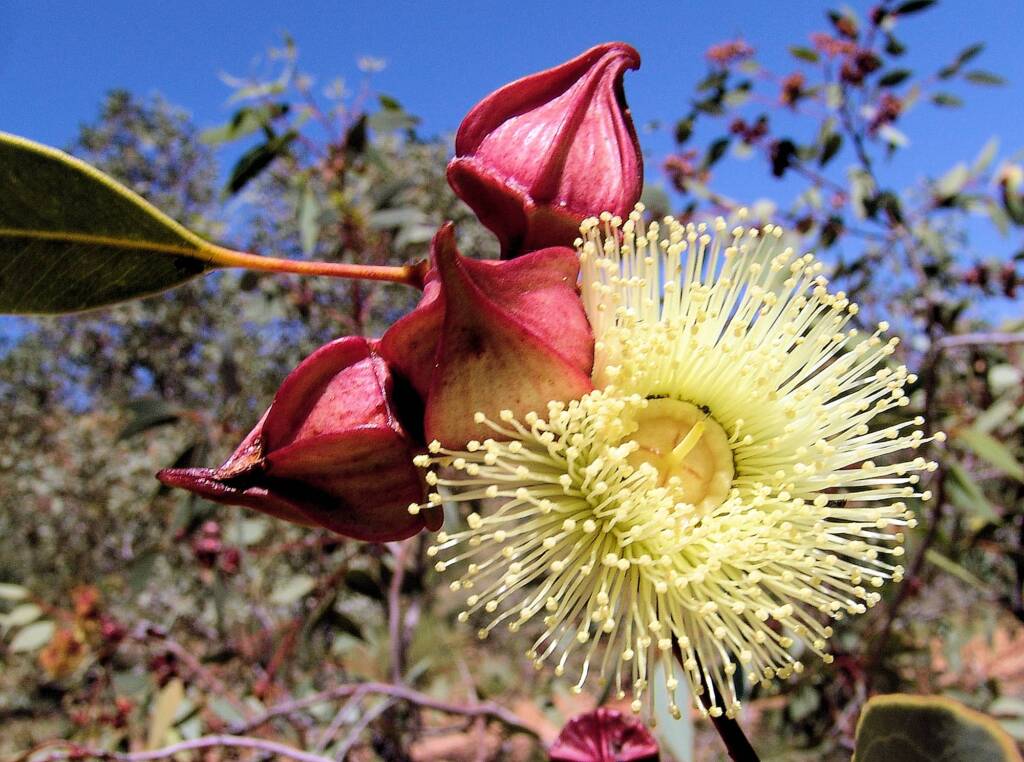
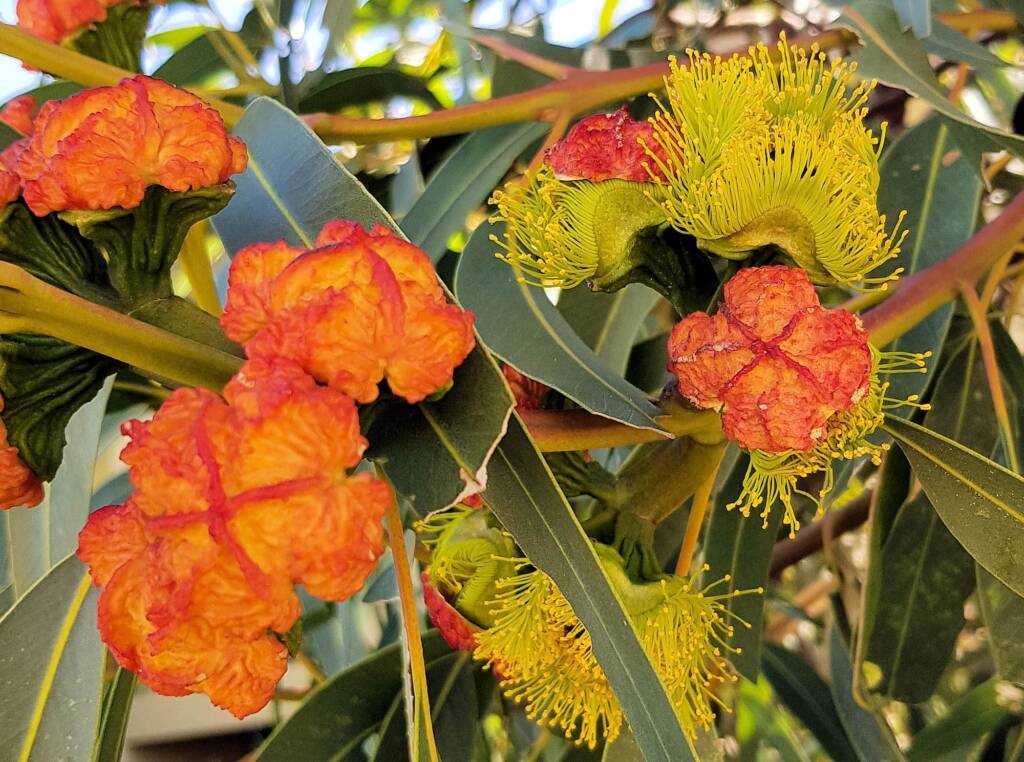
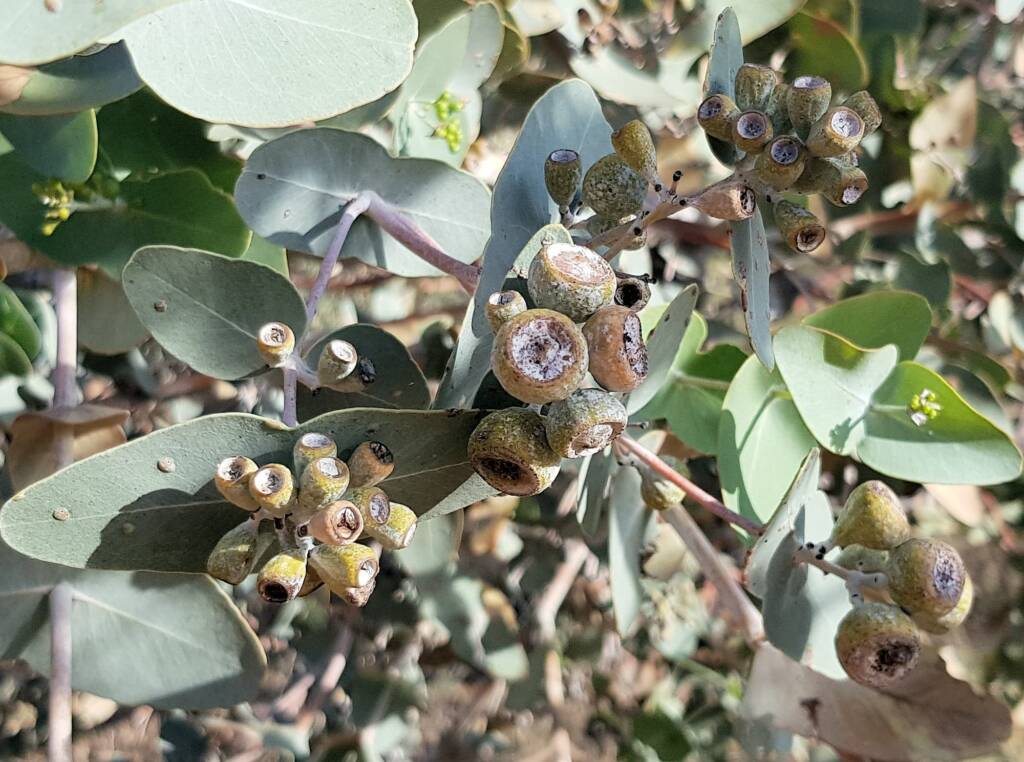
The sepals and petals of Eucalyptus are fused to form a ‘cap’ or operculum over the stamens. The fruit is a woody capsule that is commonly referred to as a ‘gumnut’.
- Blue Mallee (Eucalyptus gamophylla)
- Bushy Yate (Eucalyptus lehmannii subsp. parallela)
- Coolabah (Eucalyptus coolabah)
- Ghost Gum (Corymbia aparrerinja)
- Lemon-flowered Gum (Eucalyptus woodwardii)
- Red-bud Mallee (Eucalyptus pachyphylla)
- Red-capped Gum (Eucalyptus erythrocorys)
- River Red Gum (Eucalyptus camaldulensis)
- Scientific classification
- Kingdom: Plantae
- Clade: Tracheophytes
- Clade: Angiosperms
- Clade: Eudicots
- Clade: Rosids
- Order: Myrtales
- Family: Myrtaceae
- Subfamily: Myrtoideae
- Tribe: Eucalypteae
- Genus: Eucalyptus
- Species: there are over 700 Eucalyptus species
Footnote & References
- Eucalypts of Australia, EUCLID, https://apps.lucidcentral.org/euclid/text/intro/index.html
- Eucalyptus, https://en.wikipedia.org/wiki/Eucalyptus (last visited Jan. 2, 2021).
- Why Australia’s Severe Bushfires May Be Bad News For Tree Regeneration, by Associate Professor Lauren Bennett, Dr Sabine Kasel, Dr Tom Fairman, Ruizhu Jiang, University of Melbourne. This article was first published on Pursuit. Read the original article.
- Eucalypts and Fire – Forest Education Foundation, http://www.forest-education.com/wp-content/uploads/2017/07/eucalypt_adaptations.pdf
- Why are the Blue Mountains blue? Blue Mountains Association of Cultural Heritage Organisations, http://bluemountainsheritage.com.au/why-are-the-blue-mountains-blue/
- Gum Tree Learning: Inspiring teachers with Australian eucalypts, Merri Creek Management Committee, https://mcmc.org.au/environmental-education/environmental-education-news/708-gumtreelearning
- 9 Amazing Differences Between Eucalyptus And Gum Trees, auhor Zack DeAngelis, Tree Journey, https://treejourney.com/9-amazing-differences-between-eucalyptus-and-gum-trees/
- Myrtaceae–Eucalyptus, Angophora. Volume 19, Flora of Australia, Commonwealth of Australia, https://www.dcceew.gov.au/sites/default/files/env/pages/639cb95c-caba-408d-8657-98581bd790eb/files/flora-australia-19-myrtaceae-v2.pdf
EucalyptusEucalyptus Index Corymbia aparrerinja (Ghost Gum) Eucalyptus camaldulensis (River Red Gum) Inland River Red Gum Eucalyptus erythrocorys (Red-capped Gum) Eucalyptus gamophylla (Blue Mallee) Eucalyptus infera (Durikai Mallee) Eucalyptus orbifolia (Round Leaf Mallee) Eucalyptus lehmannii subsp. parallela Eucalyptus pachyphylla (Red-bud Mallee) Eucalyptus platypus (Coastal Moort) Insects on the Moort Eucalyptus woodwardii (Lemon-flowered Gum)
FloraFlora in Australia Flora Index Acacia Adenanthos cuneatus (Coastal Jug Flower) Agapanthus Apium prostratum subsp. prostratum var filiforme Anigozanthos (Kangaroo Paws) Apple Bush (Pterocaulon sphacelatum) Annual Yellowtop Australian Bluebell Australian Gossypium Banksia Batswing Coral Tree Billy Buttons Birdsville Indigo Blue Pincushion Bush Banana Callistemon Callitris drummondii (Drummond’s Cypress Pine) Calothamnus quadrifidus Cape Honeysuckle Cassia fistula (Golden Shower) Cattle Bush Common Heath Crotalaria Darwinia wittwerorum (Wittwer’s Mountain Bell) Daviesia oppositifolia (Rattle-pea) Desert Oaks Drumsticks Eremophila Eucalyptus Ficus Flannel Cudweed (Actinobole uliginosum) Georges Indigo Goatshead Burr (Sclerolaena bicornis) Golden Everlasting Goodenia Gossypium Grass and Grasses Grass Trees Grevillea Grey Germander Hakea Kapok Bush (Aerva javanica) Lambertia sp Leptospermum MacDonnell Ranges Cycad Maireana scleroptera Mexican Poppy Minnie Daisy Mistletoe Family Nardoo Native Apricot Nicotiana megalosiphon subspecies sessilifolia Nuytsia floribunda Orange Spade Flower Orchidaceae Parakeelyas (Calandrinia) Pebble Bush (Stylobasium spathulatum) Perennial Yellow Top Pink Everlasting Pink Rock Wort Poached Egg Daisy Portulaca Proteaceae Ptilotus Quandong Resurrection Fern Rosy Dock Ruby Saltbush Santalum Solanum Spike Centaury Spinifex Storkbill (Erodium cygnorum) Striped Mint Bush Sturt’s Desert Pea Sturt’s Desert Rose Tall Saltbush Tangled Leschenaultia Tar Vine Tribulus eichlerianus Upside-down Plant Urodon dasyphylla Variable Daisy Waratah (Telopea) Wertabona Daisy White Cedar (Melia azedarach) White Indigo White Paper Daisy Wild Passionfruit Wild Stock Woolly-Headed Burr Daisy Woolly Bush Yellow-keeled Swainsona
Flora & FaunaFauna Flora Fauna Flora Funga Glossary Funga Related Topics Scientific Classification Backyard Wildlife Floral Emblems of Australia Wildflowers