
Mistletoe FamilyHarlequin Mistletoe Pale-leaf Mistletoe Harlequin Mistletoe Yellow Form Wire-Leaf Mistletoe
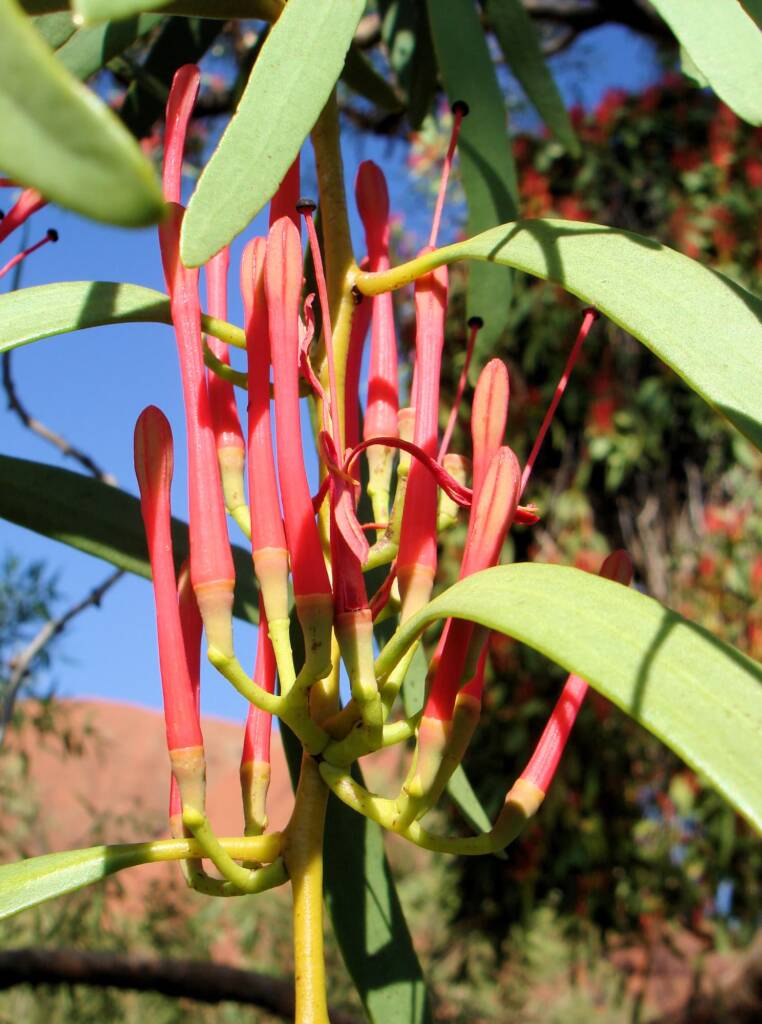
— Amyema sanguinea (at Uluru)
The family Loranthaceae, commonly known as the Mistletoe Family are a parasitic shrub or tree that has attached itself to a host plant from which they obtain water and nutrients.
There are approximately 65 genera and 900 species distributed across the southern temperate and tropical region of the world. Australia has 10 genera, with more than 80 species in two families, most of which are endemic.
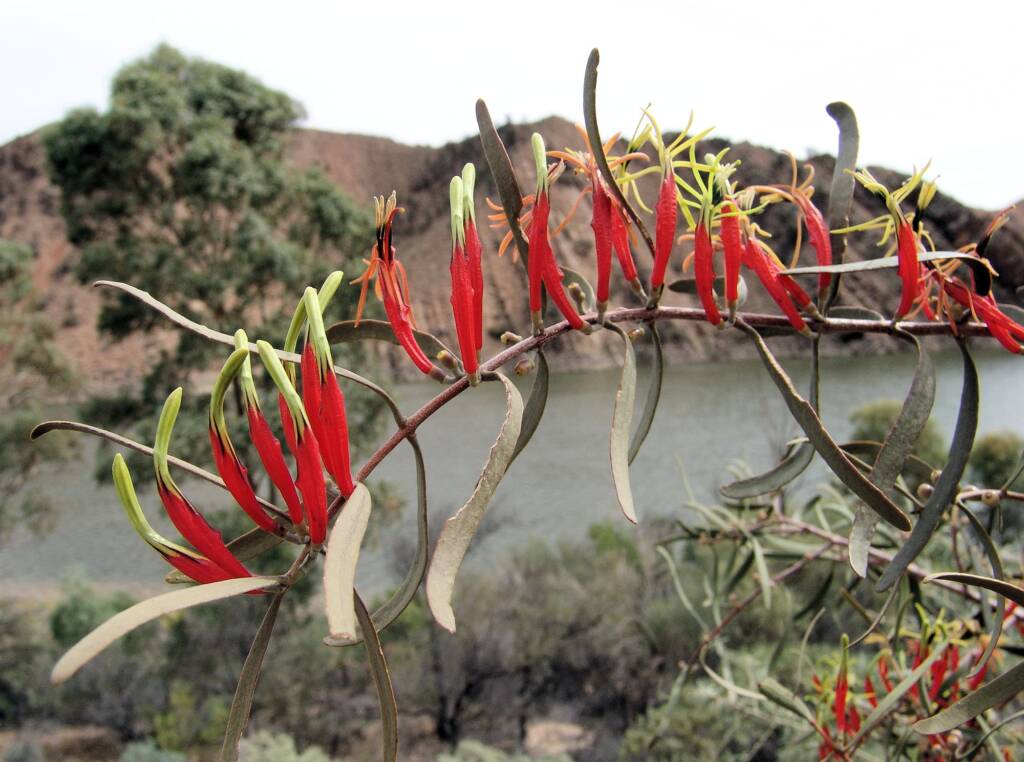
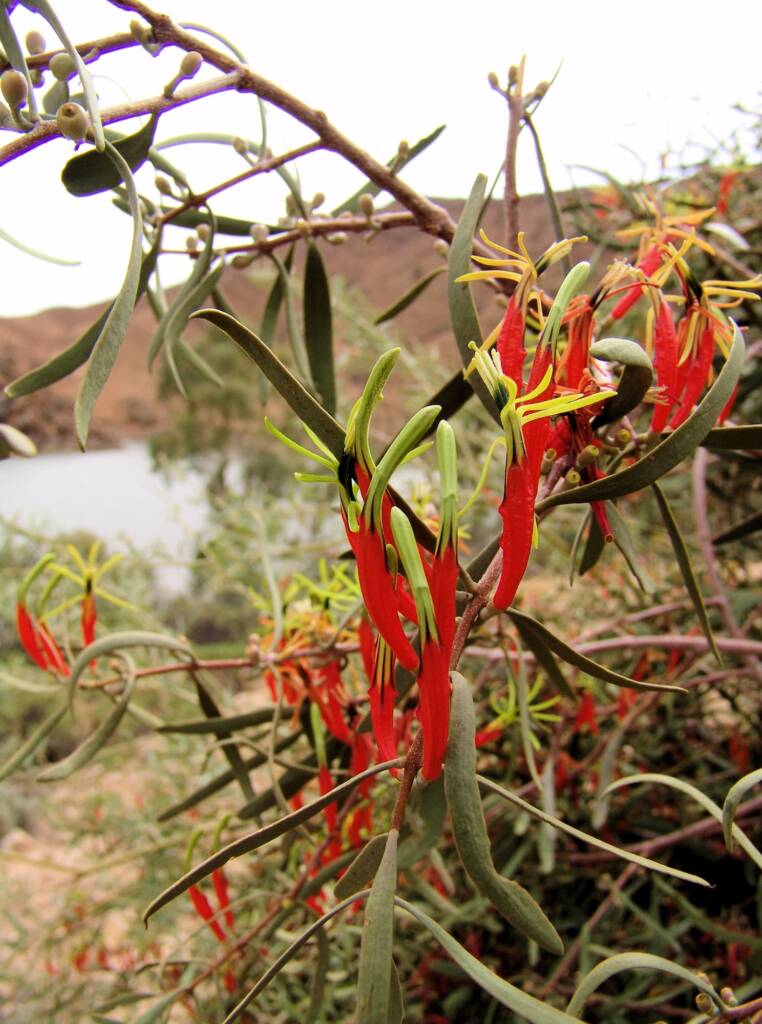
Draping from trees and shrubs, the mistletoe can vary greatly between species, although they are usually conspicuous to the host plant.
Leaves can be broad, slender or absent, although variable, they are usually opposite, with some host-specific species having leaves that do mimic the host. The flowers have 4-6 petals, corolla tubular, fused or sometimes split to the base, as found in Amyema. The fruit of the different species are yellow, red, pink, white or black, and are round, oval or pear-shaped, with an central seed covered by a sticky pulp layer that helps the seed stick to stems, as it is dispersed by birds feeding on the berry.
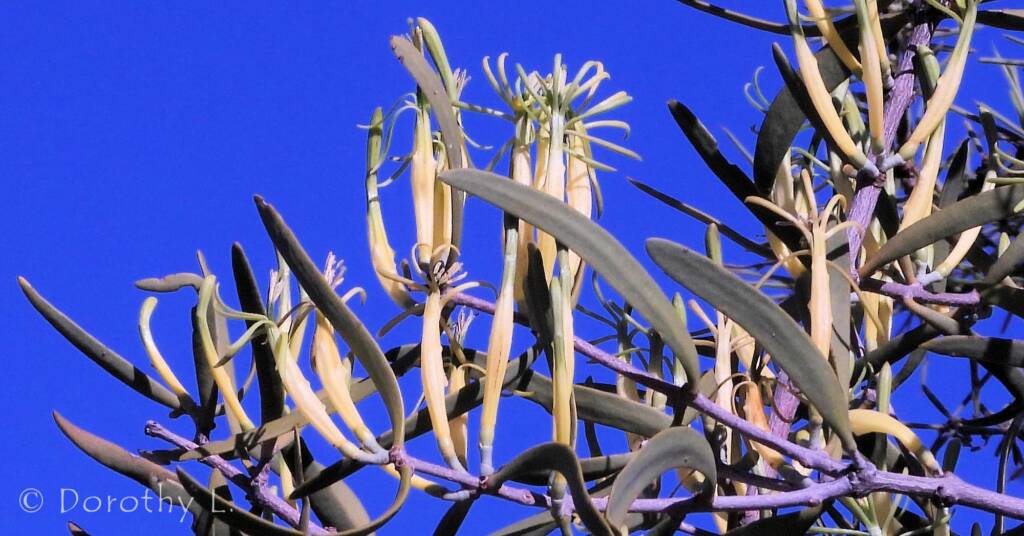
Found growing in all habitats throughout Australia, the mistletoe has even been seen to parasitise each other. Whilst there are two opposing views about the benefits of mistletoe growing on shrubs and trees, one being that they are a benefit, whilst others believe that they kill the trees they are on. Thinking logically, if the mistletoe outnumber the leaves of the tree itself, the tree will struggle as it competes with the mistletoe for water and nutrients. In such scenarios, the tree, if not already sickly, will most likely weaken and die.
The mistletoes however, does rely on the mistletoe bird to eat their fruits and voids the sticky seeds on live branches and twigs, to enable the mistletoe to germinate. Other species of birds such as the Spiny-cheeked Honeyeaters have also been witnessed eating the berries, assisting in the dispersal of the seeds.
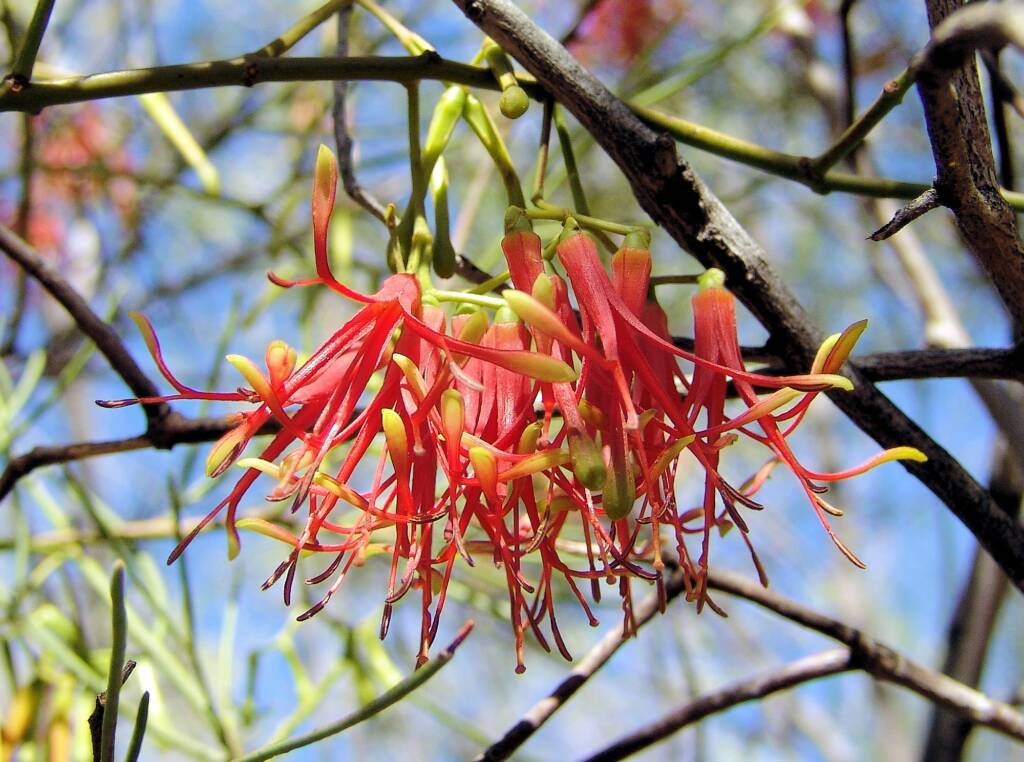
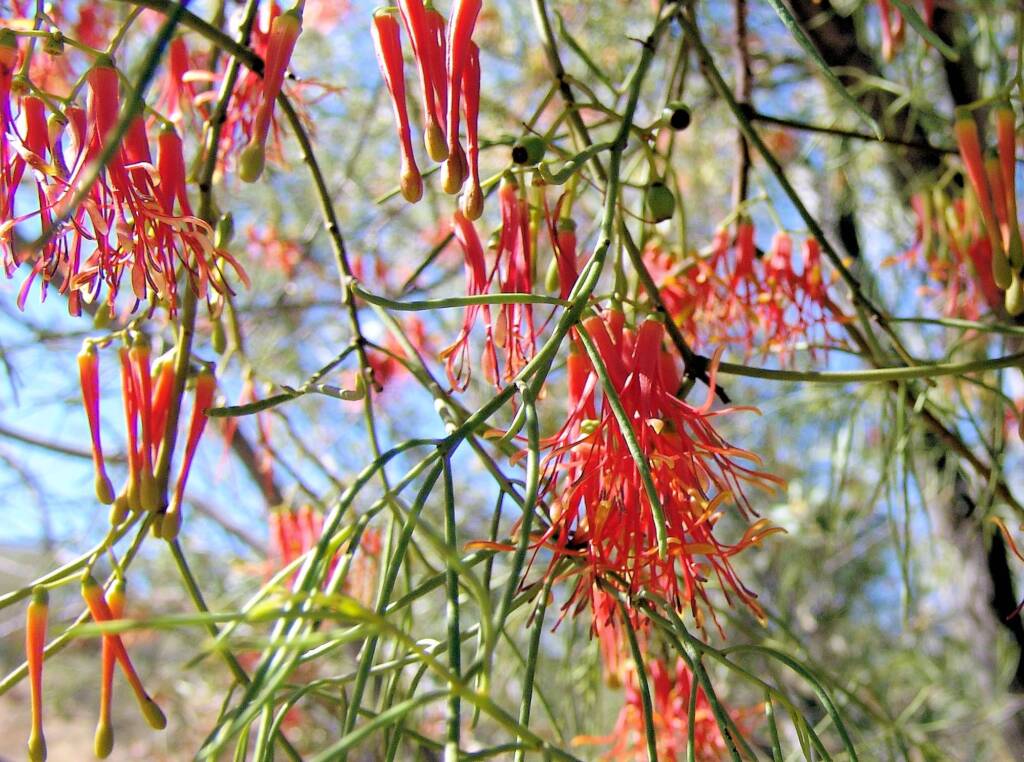
Aborigines also eat the fruits of many types of mistletoe, especially those of the Amyema and Lysiana species, though not all necessarily used.
- Amyema sanguinea Mistletoe
- Harelequin Mistletoe (Lysiana exocarpi)
- Harlequin Mistletoe Yellow Form (Lysiana exocarpi ssp. exocarpi)
- Pale-leaf Mistletoe (Amyema maidenii)
- Wire-Leaf Mistletoe (Amyema preissii)
- Scientific classification
- Kingdom: Plantae
- Division: Magnoliophyta
- Class: Magnoliopsida
- Order: Santalales
- Family: Loranthaceae
Footnote & References
- Field Guide to Australian Wildflowers, Denise Greig, New Holland Publishers, 2001, ISBN 1-86436-334-7, p. 168
- Wildflowers & Plants of Inland Australia, Anne Urban, Paul Fitzsimons, 2001, ISBN 0-646-41668-X, p. 30
- Mistletoes in Australia, Taxonomy, Australian National Botanic Gardens, https://www.anbg.gov.au/mistletoe/
Mistletoe FamilyHarlequin Mistletoe Pale-leaf Mistletoe Harlequin Mistletoe Yellow Form Wire-Leaf Mistletoe
FloraFlora in Australia Flora Index Acacia Anigozanthos (Kangaroo Paws) Annual Yellowtop Apium prostratum subsp. prostratum var filiforme Apple Bush (Pterocaulon sphacelatum) Australian Bluebell Australian Gossypium Banksia Batswing Coral Tree Billy Buttons Birdsville Indigo Blue Pincushion Bush Banana Callistemon Callitris drummondii (Drummond’s Cypress Pine) Calothamnus quadrifidus Cape Honeysuckle Cassia fistula (Golden Shower) Cattle Bush Common Heath Crotalaria Darwinia wittwerorum (Wittwer’s Mountain Bell) Daviesia oppositifolia (Rattle-pea) Desert Oaks Drumsticks Eremophila Eucalyptus Ficus Flannel Cudweed (Actinobole uliginosum) Georges Indigo Goatshead Burr (Sclerolaena bicornis) Golden Everlasting Goodenia Gossypium Grass and Grasses Grass Trees Grevillea Grey Germander Hakea Kapok Bush (Aerva javanica) Lambertia sp Leptospermum MacDonnell Ranges Cycad Maireana scleroptera Mexican Poppy Minnie Daisy Mistletoe Family Nardoo Native Apricot Nicotiana megalosiphon subspecies sessilifolia Nuytsia floribunda Orange Spade Flower Orchidaceae Parakeelyas (Calandrinia) Pebble Bush (Stylobasium spathulatum) Perennial Yellow Top Pink Everlasting Pink Rock Wort Poached Egg Daisy Portulaca Proteaceae Ptilotus Quandong Resurrection Fern Rosy Dock Ruby Saltbush Santalum Solanum Spike Centaury Spinifex Storkbill (Erodum cygnorum) Striped Mint Bush Sturt’s Desert Pea Sturt’s Desert Rose Tall Saltbush Tangled Leschenaultia Tar Vine Tribulus eichlerianus Upside-down Plant Urodon dasyphylla Variable Daisy Waratah (Telopea) Wertabona Daisy White Cedar (Melia azedarach) White Indigo White Paper Daisy Wild Passionfruit Wild Stock Woolly-Headed Burr Daisy Woolly Bush Yellow-keeled Swainsona