
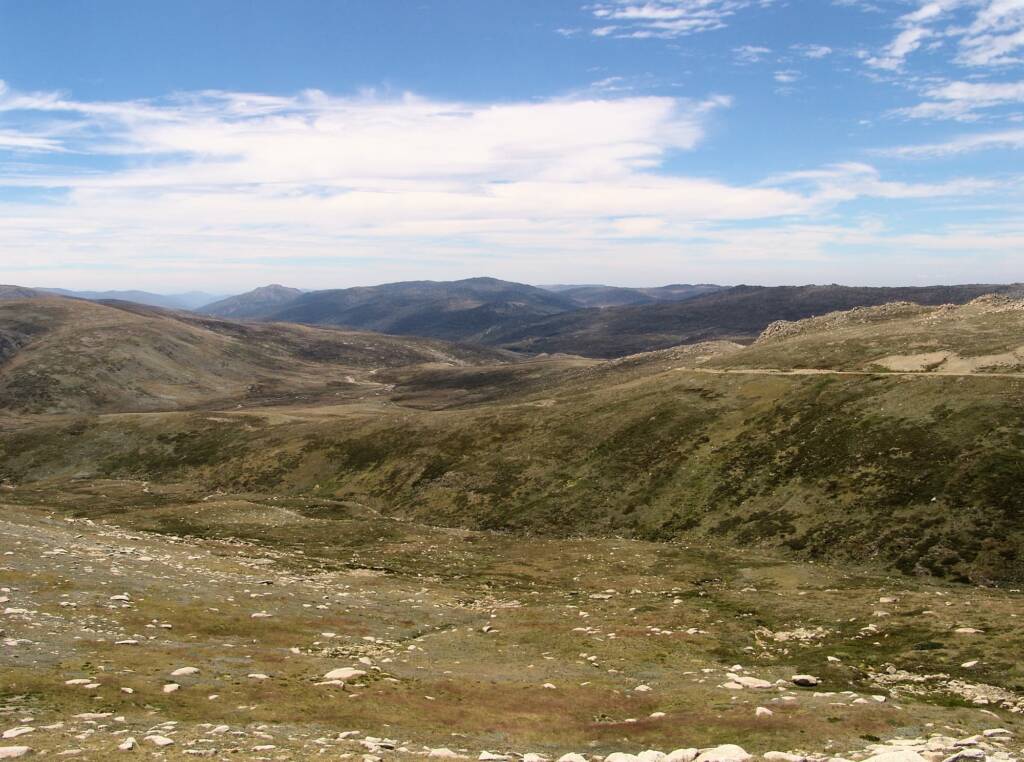
About 6,900 km2, Kosciuszko National Park is an area with glacial lakes, limestone caves, grasslands and woodlands. In winter it has some of the best skiing conditions in Australia, whilst spring and summer has the mountains alive with wildflowers. With an altitude range from 227 m along the lower reaches of the Snowy River to 2,228 m at the summit of Mount Kosciuszko, there is about six percent of the park being above the snowline.
The park has many walking tracks, some providing spectacular views over the top of Australia’s Mount Kosciuszko highest point, 2,228 m above sea level.
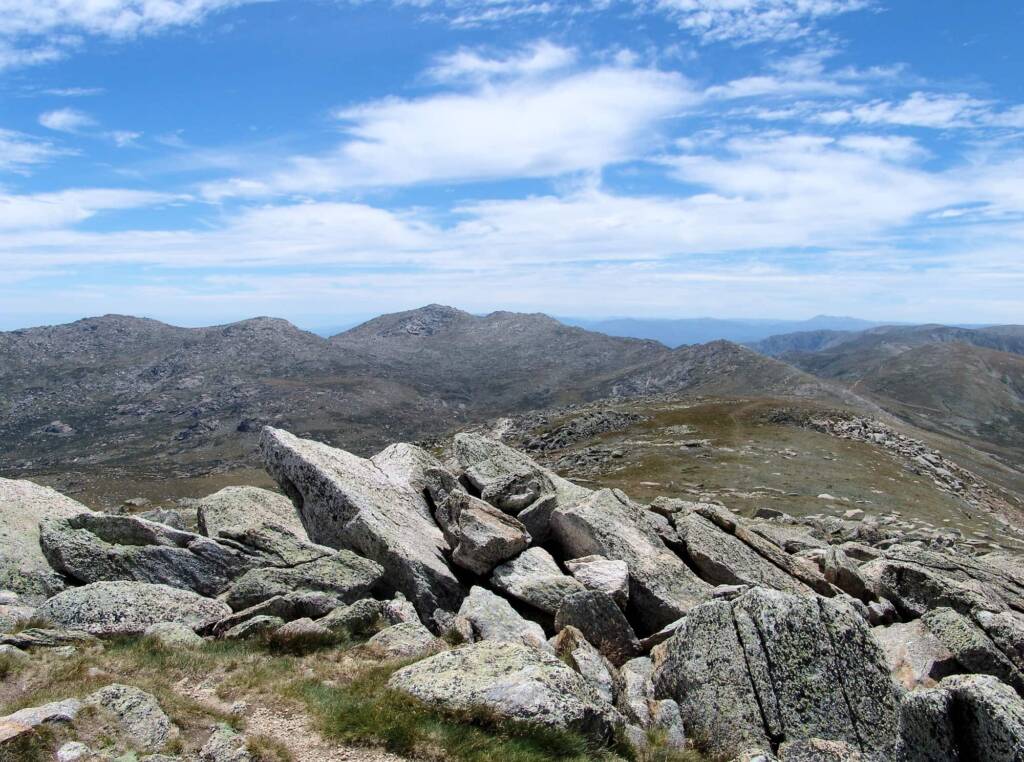
Some walks include: the old Kosciuszko Road beyond Charlotte Pass, which if the weather conditions are favourable you can use to get to the summit of Mt Kosciuszko by foot, a distance of about 9 km; an easier walk of about 6 km leaves from the top of the Crackenback Chairlift at Thredbo Village; a walk to the Kosciuszko Lookout, about 4 km return, offers great views of the mountain and the top of the range.
The park also contains six wilderness areas of about 300,000 hectares: the Byadbo, Pilot, Jagungal, Bogong Peaks, Goobarragandra and Bimberi wilderness areas. The alpine and sub-alpine areas contain rare plant species that are found nowhere else in the world, and is also home to the rare mountain pygmy possum and corroboree frog.
Kosciuszko Huts
There are high country huts and sites dotted throughout Kosciuszko National Park that are recognised as important New South Wales heritage structures.
In January 2003 some 20 huts were destroyed by bushfires and at the time NPWS advise that people not relying on huts in an emergency.
Whilst historic huts restoration and maintenance continue, tourism and travellers can check on the status of huts they plan to visit on the National Parks & Wildlife Service and the Kosciuszko Huts Association websites (see Footnote & References below).
People planning back country expeditions during winter in Kosciuszko National Park should be well prepared and not rely on emergency shelter.
Don’t rely on a hut in an emergency. Make sure you register details of your proposed journey with friends or relatives and hire an EPIRB (Emergency Position Indication Radio Beacons) from NPWS visitor centres.
If you wish to get involved with restoration and maintenance of these huts, volunteer with Kosciuszko Huts Association.
Additional information about the huts can be found on the Kosciuszko Huts Association website (see Footnote below).
Kosciuszko National Park – Aboriginal History
When the first Aborigines entered Australia through Cape York Peninsula some 50,000 or more years ago, the Kociusko Plateau located some 3,000 km to the south east, was still very much in the ice ages. It is estimated that Aborigines took up permanent residence on the Monaro Plains at the base of the Kosciuszko plateau from 5,000 to 15,000 years ago.
The Aborigines who came to live on the edge of the mountains eventually formed four major tribal groups; the YA-itmathang, the Wolgal, the Waradgery and the Ngarigo. The high parts of the ranges was a no-mans land, held in trust for all the tribes and most certainly unoccupied during the winter months. In the spring, it became a great meeting place where people gathered in their thousands for ceremonies and the annual feasting on the Bogong moth, which was considered a great delicacy.
Source: NSW National Parks and Wildlife Service and Thredbo Information Centre
Kosciuszko National Park – Sir Paul Edmund Strzlecki
Paul Edmund de Strzelecki was born in Poland at Gluszyna, near Poznan on July 20th, 1797 and arrived in Australia on April 25th, 1839.
From 1839 to 1843 he explored and surveyed vast areas of New South Wales, Victoria and Tasmania.
Whilst exploring in the Snowy Mountains region of New South Wales he was the first European to discover and climb Australia’s highest peak, Mount Kosciuszko, which he named in honour of the Polish leader and patriot Tadeusz Kosciuszko.
Sir Paul Edmund Strzlecki, a renowned explorer and scientist, contributed greatly to the knowledge and development of Australia.

Photographic portrait of Paweł Edmund Strzelecki, ca 1845 (defects reduced).jpg, https://commons.wikimedia.org/w/index.php?title=File:Photographic_portrait_of_Pawe%C5%82_Edmund_Strzelecki,_ca_1845_(defects_reduced).jpg&oldid=607877607 (last visited January 11, 2022).
Kosciuszko National Park – The Village
Thredbo located in the Kosciuszko National Park, is one of Australia’s highest alpine towns at 1,365 to 1,930 metres above sea level (Cabramurra is the highest town).
The area known as Thredbo Village had been used by early graziers when, in 1955, a Czech by the name of Tony Sponar, working as a hydrographer for the Snowy Mountains Authority, realised the great potential of the area as a Ski Resort. Sponar had been a ski instructor at St Anton, Austria, from 1941 to 1948 and saw Thredbo developing with the same atmosphere as at St Anton.
In May 1955, the Kosciusko chairlift and Thredbo Hotel Syndicate was formed and subsequently acquired a lease from the state government with the idea of developing a year-round resort. The initiating directors were Tony Sponar, Charles Anton, Eric Nicholls and Geoffrey Hughes.
In the winter of 1995, a study of weather and snowfall characteristics of the area was made. By the end of that year it was decided that the Friday Flat/Crackenback Peak area was best suited for development and a line was cleared and surveyed for a proposed chairlift on Crackenback Peak. In October 1955 Andrew Thyne Reid joined the syndicate.
In January 1957 the State Park Trust gave the syndicated an option for a lease, and work began in the summer of 1956-1957 on a chairlift and basic accommodation.
Tony Sponar was the first area manager and had a budget, in 1957,of 4000 pounds to build a road from the Alpine Way to the present site of the Thredbo Alpine Hotel and 1,000 pounds to build a lodge.
In May 1957 the syndicated was renamed and reorganised into Kosciusko Thredbo Limited. Andrew Thyne Reid was the Chairman and through his experience with the James Hardie Company, raised the money for the continuing development of Thredbo.
To obtain a 99 year lease the group had to build a ski lift and a 100 bed hotel within 5 years. After 31/2 years it was clear the group needed a partner with more financial strength and construction expertise. Tyne Reid negotiated with the bidders, McGrath Coach Houses and Lend Lease.
In 1961, Lend Lease acquired the lease and until 1987 the company developed Thredbo into the most unique alpine resort in Australia, the only one to operate year round.
In January 1987, Amalgamated Holdings Limited, known to most as the Greater Union Organisation, purchased the lease and since hen Thredbo has gone ahead in leaps and bounds. In summer 1987/88, major developments of some $30 million were undertaken including the largest snowmaking system in the southern hemisphere and the installation of two state-of-the-art detachable quad chairs.
The Village can accommodate approximately 4,300 people with a permanent population of 250 to 300 people. Since 1996 over $130 million has been invested in the upgrading of the mountain and village facilities.
Source: Extract from the Thredbo Village self-guided heritage walk
available from the Thredbo Information Centre
Footnote & References
- National Parks & Wildlife Service, https://www.nationalparks.nsw.gov.au/
- Kosciuszko Huts Association, https://khuts.org/
- Paul Edmund de Strzelecki, Australian Museum, https://australian.museum/about/history/exhibitions/trailblazers/paul-edmund-de-strzelecki/
SydneySydney Art Sydney Accommodation Sydney Attractions Sydney Cityscape Darling Harbour Sydney Fauna Sydney Flora
New South WalesBarunguba Montague Island Bourke Blue Mountains Bundeena Central Coast Kosciuszko National Park Mount Kaputar National Park Lower North Shore Northern Beaches Sapphire Coast Snowy Mountains Region South Coast Stony Range Regional Botanic Garden Sydney